
How to calculate NCI (Non controlling interests)
Understanding Non-Controlling Interests in Group Consolidation
Non-controlling interests trip up more consolidations than almost any other line item. The concept is simple on paper, messy in practice. A non-controlling interest is the portion of a subsidiary's equity that the parent doesn't own, held instead by outside shareholders.
NCI shows up whenever a parent controls a subsidiary without owning all of it. Typically that means more than 50% but less than 100%. The parent consolidates the full subsidiary line by line, then carves out the slice that belongs to those minority shareholders. Under U.S. GAAP, the ASC master glossary from Deloitte DART defines NCI as the portion of equity in a subsidiary not attributable, directly or indirectly, to a parent. IFRS 10 takes the same position, requiring the IFRS Foundation's standard that NCI sit within equity, separately from the equity attributable to the parent's owners.
This article walks through what NCI actually is, why it matters for group financial statements, how it arises during consolidation, and how to calculate it step by step. The goal is a working understanding finance teams can apply at month-end, not just a textbook definition.
What Is a Non-Controlling Interest?
A non-controlling interest is the equity in a consolidated subsidiary that doesn't belong, directly or indirectly, to the parent. That definition, taken from ASC 810-10-20 and confirmed by Deloitte DART, matters because it draws a hard boundary. NCI is equity. Not debt, not a provision, not a plug.
Older financial statements called this line minority interest. The term is still floating around in board papers and legacy templates, and ASC 810 itself notes via Deloitte DART that non-controlling interests are sometimes called minority interest. IFRS 10 and ASC 810 formalised the rename to reflect a more accurate picture: these shareholders own a real economic stake in the subsidiary, even if they don't call the shots.
On the consolidated balance sheet, NCI sits inside the equity section, presented separately from the equity attributable to the owners of the parent. It is never a liability. That distinction shapes gearing ratios, return on equity calculations, and every covenant tied to equity.
NCI also represents a genuine claim. Outside shareholders are entitled to their proportional share of the subsidiary's net assets and its post-acquisition profits. When the subsidiary pays a dividend, part of that cash leaves the group entirely.
One point often blurred: NCI applies to subsidiaries that are fully consolidated. Associates and joint ventures follow a different path. Those investments are picked up using the equity method, where the group recognises its share of results through a single line, without consolidating 100% of the underlying assets. If there's no control, there's no NCI. That single test, control, decides which accounting model applies before any calculation begins.
Why Non-Controlling Interests Matter in Consolidated Financial Statements
Full consolidation is an all-or-nothing exercise. Once control exists, 100% of the subsidiary's assets, liabilities, revenues and expenses land in the group accounts, regardless of whether the parent owns 60% or 95%. That mechanic is what forces NCI into existence. Without it, the balance sheet simply wouldn't balance, because equity would understate the net assets brought in.
NCI is the plug that makes the arithmetic work, but treating it like a plug is where consolidations quietly go sideways. IFRS 10 requires the parent to attribute profit or loss and other comprehensive income between owners of the parent and non-controlling interests, per the IFRS Foundation. ASC 810 mirrors this on the presentation side, with Deloitte confirming the requirement to show consolidated net income and consolidated comprehensive income separately for the portions attributable to the parent and NCI on the face of the financial statements.
Those splits ripple through everything. EPS is calculated on earnings attributable to the parent, not consolidated profit. Return on equity depends on which equity balance you use. Dividend policy for the parent's shareholders can't legitimately draw on profits owed to minority holders sitting in a subsidiary. Get the split wrong and every downstream ratio is wrong.
Here's the contrarian view most finance teams miss: NCI is often small in dollar terms and therefore assumed to be low risk. Auditors don't share that view. NCI disclosures are scrutinised heavily under IFRS 12 and ASC 810 precisely because the calculation touches acquisition accounting, goodwill, OCI reallocation, and equity movements all at once. Small balance, high complexity. That's exactly the profile that produces material misstatements and audit adjustments. Teams that want to understand where consolidations break down under audit review can find useful patterns in our published audit-failure analysis.
How Does a Non-Controlling Interest Arise During Consolidation?
NCI is a mechanical consequence of control without full ownership. The moment a parent obtains control of a subsidiary, typically by holding more than 50% of the voting rights, full consolidation kicks in. Under ASC 810, consolidation is required even when the parent does not own 100% of a subsidiary, according to Deloitte DART, and that gap between control and full ownership is exactly where NCI lives.
The sequence looks like this:
- Control test. The parent establishes control, usually through majority voting rights, though other rights and arrangements can also trigger control under IFRS 10.
- Full line-by-line combination. 100% of the subsidiary's assets, liabilities, income, and expenses roll into the group accounts. Intercompany balances and transactions are eliminated.
- Measure NCI at acquisition. Under IFRS, choose between fair value or the proportionate share of the subsidiary's identifiable net assets. The choice drives whether goodwill is recognised on a full or partial basis.
- Update NCI each period. Add the NCI's share of post-acquisition profit and OCI, subtract dividends paid to those minority holders, and adjust for any equity transactions.
A simple example. Suppose a parent acquires 80% of a subsidiary whose identifiable net assets are worth $10 million at acquisition. Under the partial goodwill method, NCI is recognised at 20% of $10 million, or $2 million, and sits inside group equity from day one. If the subsidiary then earns $1 million in the following year and pays no dividend, NCI increases by 20% of $1 million, or $200,000, taking the closing balance to $2.2 million.
One critical guardrail: only equity interests qualify. Under ASC 810, a non-controlling interest can only exist if the other party holds an equity ownership interest in the subsidiary, per Deloitte DART, and liabilities cannot be reclassified as NCI. That rule matters in complex capital structures, in multi-level subsidiary chains where NCI compounds through each layer, in stepped acquisitions that cross the control threshold, and in loss-making subsidiaries where NCI can go negative. For a deeper mechanical walkthrough, our guide on how to calculate NCI covers the edge cases in more detail.

How to Calculate Non-Controlling Interests: Step-by-Step
The NCI calculation has two anchor points. First, the value at acquisition. Second, the roll-forward each reporting period. Get those two right and the rest is bookkeeping.
NCI at acquisition. Under IFRS 10, the parent chooses between two measurement approaches, a choice confirmed by the IFRS Foundation as either fair value or the proportionate share of the acquiree's identifiable net assets. The choice is made per acquisition, not as a group-wide policy.
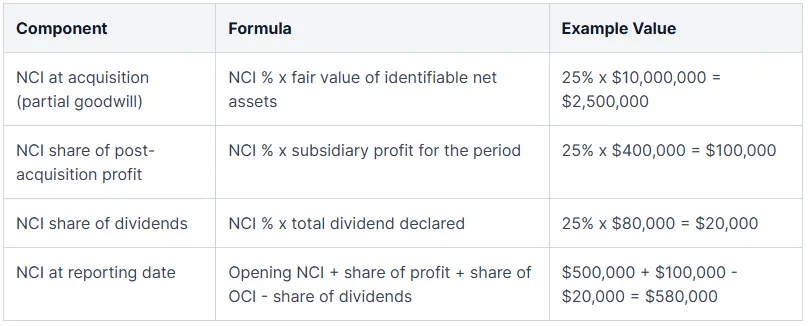
- Partial goodwill method: NCI = NCI % x fair value of subsidiary's identifiable net assets
- Full goodwill method: NCI = fair value of the NCI (typically based on the market price of the shares held by minority investors)
The partial goodwill method keeps NCI smaller and recognises goodwill only on the parent's share. The full goodwill method grosses up both NCI and goodwill, giving a larger balance sheet impact. Neither is more correct. They tell different stories about the same acquisition. Deciding when to fair value acquired assets is a related judgement call worth thinking through carefully.
NCI at the reporting date. The formula is a simple roll-forward:
Opening NCI + NCI share of profit + NCI share of OCI - NCI share of dividends = Closing NCI
Under IFRS 10, both profit or loss and each component of other comprehensive income must be allocated between NCI and the parent, per the IFRS Foundation. Ownership percentage drives the allocation unless a different arrangement applies contractually.
Worked example. A parent owns 75% of a subsidiary. Subsidiary profit for the year is $400,000, and it declares a $80,000 dividend. NCI's 25% share of profit is $100,000. NCI's 25% share of the dividend is $20,000. If opening NCI was $500,000 and OCI is nil, closing NCI is $500,000 + $100,000 - $20,000, or $580,000.
Income statement. Consolidated profit is split on the face of the P&L between amounts attributable to owners of the parent and to NCI.
Balance sheet. NCI is presented as a distinct line inside equity.
Statement of changes in equity. Every movement, share of profit, dividends, OCI, ownership changes, is tracked separately for NCI.
Journal entries at a glance. At acquisition: Dr Investment in subsidiary, Cr NCI (for the NCI portion of net assets acquired). Each period: Dr P&L attributable to NCI, Cr NCI, then Dr NCI, Cr Dividends payable for the minority share of distributions. (The partial goodwill method)

NCI Under IFRS vs US GAAP: Key Differences
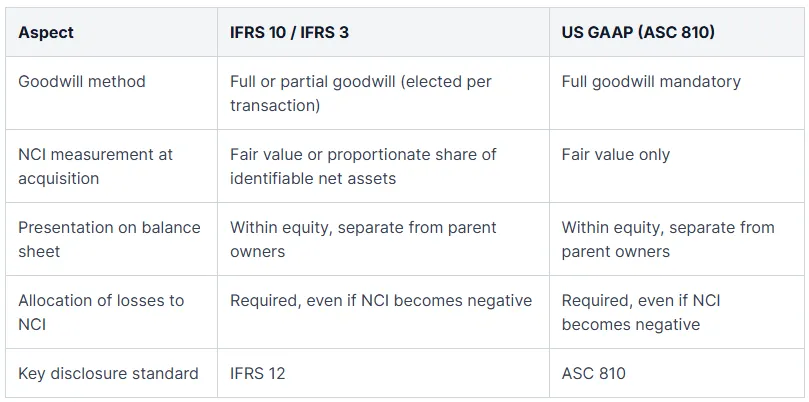
The frameworks converge on the big question and diverge on the mechanics. Both IFRS 10 and ASC 810 park NCI inside equity, separately from the parent's owners. That much is settled. IFRS Foundation guidance is unambiguous on the equity classification, and Deloitte's roadmap confirms the same treatment under US GAAP.
The divergence starts at acquisition. US GAAP mandates a single approach: NCI is measured at fair value, producing full goodwill on 100% of the subsidiary. IFRS gives you a choice, transaction by transaction. You can measure NCI at fair value (full goodwill) or at the proportionate share of identifiable net assets (partial goodwill).
This is not a cosmetic difference. The partial goodwill route understates both goodwill and the NCI balance versus the full goodwill route. On a large acquisition with a meaningful NCI stake, the gap can shift group equity and goodwill impairment testing materially.
Disclosure rules diverge too. IFRS 12 governs disclosures for interests in other entities and requires detailed information about subsidiaries with material NCI. ASC 810 keeps disclosure obligations inside the same standard as recognition and measurement, with specific reconciliations of equity movements attributable to the parent and NCI separately.
For dual reporters, the practical guidance is straightforward. Pick a consistent IFRS measurement policy up front. Document the fair value calculation for every acquisition. Reconcile the goodwill difference between frameworks in your working papers. Finance teams running parallel books cannot afford ad-hoc choices on each deal, because the downstream impact on segmental reporting and impairment reviews compounds fast.
Common NCI Pitfalls in Multi-Currency and Multi-Entity Groups
NCI errors cluster around a handful of predictable failure modes. Multi-currency and multi-level structures amplify every one of them.
The foreign currency translation reserve is where most botched consolidations begin. When a foreign subsidiary is translated into the group's presentation currency, the FCTR that arises must be split proportionately between the parent and NCI. A common error is dumping 100% of the FCTR movement into parent equity. It balances the trial balance, but it overstates parent reserves and leaves the NCI balance carrying the wrong translation history. Our Resources library covers the mechanics in depth.
Stepped acquisitions are the next trap. When a parent increases its stake without losing or gaining control, the adjustment flows through equity, not the income statement. IFRS 10 is explicit: changes in ownership without loss of control are equity transactions and never touch P&L. Teams still book gains or losses to earnings by reflex. The audit finding writes itself.
Deficit subsidiaries catch out finance teams who assume NCI has a floor at zero. It doesn't. Losses must be allocated to NCI in proportion to ownership, even when the NCI balance turns negative. Both frameworks are aligned on this.
Multi-level structures compound the problem. Effective ownership through intermediate holding companies rarely equals the direct percentage. Get the effective calculation wrong at level two, and every downstream allocation drifts.
Spreadsheet consolidations magnify all of the above. One broken link across a currency-translated NCI schedule, and the group financial statements are out before month-end even closes.
Frequently Asked Questions About Non-Controlling Interests
What is the difference between non-controlling interest and minority interest?
They describe the same concept. 'Minority interest' was the historical term used before IFRS 10 and ASC 810 standardised the language. The updated term reflects a practical reality: a non-controlling holder is not always a small or passive investor. Some hold significant blocks and exert real influence, even without control.
Is non-controlling interest a liability or equity?
Equity. Both IFRS 10 and ASC 810 require NCI to be presented within the equity section of the consolidated balance sheet, separately from equity attributable to the parent's owners. Classifying NCI as a liability is a common legacy error carried over from pre-2008 accounting practice and will fail audit review under current standards.
How is NCI calculated at acquisition?
Two methods exist. The partial goodwill method measures NCI as the NCI percentage multiplied by the fair value of the subsidiary's identifiable net assets. The full goodwill method measures NCI at fair value, producing goodwill on 100% of the acquired business. US GAAP requires the full goodwill method. IFRS permits either, elected per transaction.
Can non-controlling interest be negative?
Yes. When a subsidiary generates losses that exceed the NCI's equity balance, the NCI balance turns negative. Both IFRS 10 and ASC 810 require losses to be allocated to NCI in proportion to ownership, even where this produces a deficit balance. The NCI does not have a floor at zero.
How does NCI affect the income statement?
Group profit is presented in total, then attributed between owners of the parent and non-controlling interests based on ownership percentages. The split appears at the bottom of the consolidated income statement. Other comprehensive income is allocated the same way, so both profit and OCI carry a parent line and an NCI line.
Do non-controlling interests share in foreign currency translation reserves?
Yes. When a subsidiary reports in a functional currency different from the group's presentation currency, the FCTR arising on translation must be allocated proportionately between the parent and NCI. Allocating 100% of the FCTR to parent equity is a frequent error that overstates parent reserves and understates the NCI balance.
Automate NCI Calculations with Quick Consols
NCI is where spreadsheet consolidations quietly break. One deal with a partial goodwill election, one foreign subsidiary with an FCTR to split, one stepped acquisition booked to the wrong side of the equity line, and the group financial statements need reworking days before sign-off.
Quick Consols automates NCI allocation across the balance sheet, income statement, and statement of changes in equity. The platform handles proportionate FCTR splits, stepped acquisitions treated as equity transactions, and deficit subsidiaries where NCI has to absorb its share of losses. Multi-level structures resolve through effective ownership without a separate working paper. Every allocation is auditable, and every roll-forward reconciles automatically.
Finance teams running month-end across multiple currencies and multiple entities stop rebuilding NCI schedules by hand and start reviewing outputs. Manual reprocessing time drops. Audit queries shrink. The consolidated numbers hold up under review.
See how Quick Consols handles Group Financial Consolidation end to end, and book a demo to walk through your own group structure with the team.

Share this Article


Get in Touch
If you have any questions about our Consolidation Software, send us a message below and we'll get back to you ASAP.
Read this next
.webp)