
Why Non-Controlling Interests share in the Foreign Currency Translation Reserve
Introduction: The Link Between NCI and Foreign Currency Translation
Consolidating a group that operates across borders is where multi-currency reporting quietly punishes finance teams. Each subsidiary keeps its books in a functional currency. The parent reports in a different presentation currency. The gap between those two currencies has to land somewhere in the consolidated accounts, and that landing spot is the foreign currency translation reserve.
Non-controlling interests sit inside this picture too. NCI represents the slice of a subsidiary's equity that belongs to minority shareholders, not the parent. If a parent owns 70% of a foreign subsidiary, the remaining 30% belongs to NCI. They share in profits. They share in net assets. And here is where many practitioners stumble: they also share in the (Under IAS 21) translation gains and losses sitting in the FCTR.
This is not a quirk of practice. Under IAS 21, exchange differences on the net investment in a foreign operation are recognised in OCI, and the portion attributable to minority shareholders must be allocated to NCI in the consolidated balance sheet. Get this split wrong, and the equity section will not reconcile.
What Is the Foreign Currency Translation Reserve?
The foreign currency translation reserve is the equity bucket that absorbs exchange differences when a foreign subsidiary's financials are translated into the group's presentation currency. It is an accumulated balance, not a one-off entry. Every reporting period adds another layer to it.
IAS 21 sets the mechanics. Assets and liabilities of a foreign operation are translated at the closing rate at the reporting date. Income and expenses are translated at the rates ruling at the transaction dates, with an average rate permitted as a practical expedient. Equity components are typically carried at historical rates from the date they arose.
That mix of rates is precisely what creates the translation difference. Opening net assets translated at last year's closing rate look different when retranslated at this year's closing rate. Profit translated at average rates does not equal profit translated at closing. Goodwill and fair value adjustments on acquisition ride along too, also retranslated at closing under IAS 21.
The resulting exchange differences do not touch profit or loss. They flow through other comprehensive income and accumulate inside FCTR as a separate component of equity. Until the foreign operation is disposed of, the balance sits there as an unrealised translation effect. On disposal, it gets recycled out of equity into profit or loss. For finance teams running automated consolidation cycles, getting the rate inputs right at trial balance level is what makes the FCTR roll forward defensible to auditors. Our Resources walk through the calculation step by step.

What Are Non-Controlling Interests in a Group Structure?
Non-controlling interests are the equity stake in a subsidiary that the parent does not own. The label is precise. NCI is not a liability. It is not a separate company. It is the minority shareholders' claim on the subsidiary's net assets, presented inside the consolidated equity section.
Take a typical multi-entity structure. A parent acquires 70% of a foreign subsidiary. The remaining 30% stays with outside shareholders. Under IFRS 10, the parent must fully consolidate that subsidiary because it controls it. Every asset, every liability, every line of revenue and expense comes into the consolidated trial balance at 100%.
But control is not the same as ownership. Profit is split. Equity is split. After consolidation, the group's income statement shows profit attributable to owners of the parent and profit attributable to NCI as separate lines. The balance sheet does the same on the equity side. NCI sits within total equity, separately disclosed from parent equity.
This matters for the FCTR conversation. If 30% of the subsidiary's net assets economically belong to NCI, then 30% of any translation effect on those net assets also belongs to them. Industry guidance from BDO confirms that exchange differences relating to a non-wholly-owned foreign operation are recognised in OCI and allocated between controlling and non-controlling interests in equity. The allocation is not optional. It is the only treatment that keeps consolidated equity in agreement with the underlying subsidiary equity once translated.
Why Do NCI Share in the Foreign Currency Translation Reserve?
The direct answer is straightforward. NCI owns a proportionate slice of the subsidiary's net assets. When those net assets are retranslated each period, the resulting translation gain or loss attaches to whoever owns them. The parent owns its share. NCI owns the rest. The FCTR follows the equity it relates to.
IAS 21.41 makes this explicit. Accumulated exchange differences arising on translation of a foreign operation that is not wholly owned must be allocated to, and recognised as part of, non-controlling interests in the consolidated statement of financial position. There is no parent-only carve-out in the standard. The same IAS 21 framework that sends exchange differences on the net investment to OCI also requires those differences to be split between controlling and non-controlling shareholders.
This is where audit findings start. Some practitioners treat FCTR as a parent-level adjustment and book the full translation difference against parent equity. The logic feels intuitive, since FCTR arises from translating into the parent's presentation currency. But it is incorrect. The FCTR reflects movements in the underlying net assets of the subsidiary, and those net assets are not 100% owned by the parent in a non-wholly-owned structure.
The reconciliation proof is the cleanest test. (KPMG's implementation guidance) Take the subsidiary's closing equity in its functional currency, translate it at the closing rate, and compare it to the consolidated carrying amounts of parent share plus NCI. The two figures must agree. If NCI does not pick up its share of FCTR, the consolidated equity will be understated and the NCI balance will not tie back to the subsidiary's translated equity. The economic story matches the accounting one: minority shareholders bear currency risk on their portion of the subsidiary's assets, so they share in the translation outcome too. For groups running complex multi-currency consolidations, our Resources unpack the mechanics in detail.
Worked Example: Allocating FCTR Between Parent and NCI
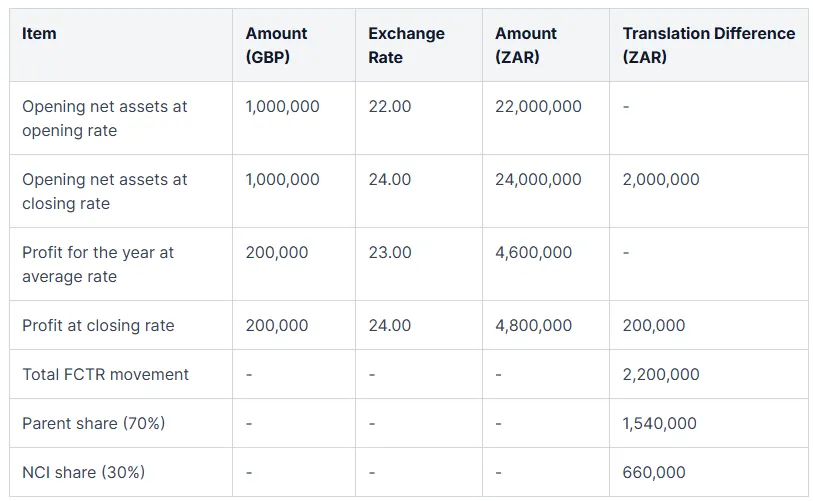
A concrete walkthrough makes the allocation obvious. Assume a South African parent reporting in ZAR acquires 70% of a UK subsidiary on 1 January. The subsidiary's functional currency is GBP. Opening net assets at acquisition are GBP 1,000,000. Profit for the year is GBP 200,000.
The rates for the year are:
- Opening rate: 1 GBP = 22 ZAR
- Closing rate: 1 GBP = 24 ZAR
- Average rate: 1 GBP = 23 ZAR
Step one is the translation of opening net assets. At the opening rate, the GBP 1,000,000 equates to ZAR 22,000,000. At the closing rate, the same GBP 1,000,000 equates to ZAR 24,000,000. The difference of ZAR 2,000,000 is a translation gain on opening equity, driven entirely by the strengthening of the GBP against the ZAR. Under IAS 21, this goes to OCI and accumulates in FCTR.
Step two handles the profit. Profit for the year is translated at the average rate, giving ZAR 4,600,000. If that same profit had been translated at the closing rate, it would have come through at ZAR 4,800,000. The ZAR 200,000 difference is the translation gain on profit earned during the year. The average rate is the permitted practical expedient for income and expenses under IAS 21.
Step three sums the movement. Total FCTR for the year is ZAR 2,200,000. Step four allocates it. The parent picks up 70%, or ZAR 1,540,000, in its share of FCTR within equity attributable to owners of the parent. NCI picks up 30%, or ZAR 660,000, recognised inside the NCI balance.
The reconciliation closes cleanly. Translated closing equity (opening net assets plus profit, both at closing rate) equals ZAR 28,800,000. Parent equity carrying 70% of that, plus its share of FCTR, agrees to NCI carrying its 30% slice. For finance teams choosing rates inside a multi-entity consolidation, our Resources cover which rate to use where.
How to Present NCI's Share of FCTR in Consolidated Financial Statements
Presentation is where allocation work either holds up under audit or unravels. The statement of changes in equity should split translation differences into two columns: one attributable to owners of the parent, the other to NCI. Each column moves independently across the period. Opening balance, current-year OCI movement, dividends, closing balance. Auditors expect to trace every line.
In the statement of comprehensive income, the OCI section should disclose total comprehensive income at the bottom, split between parent and NCI. The FCTR line within OCI gets the same treatment. This split is not optional. BDO's guidance is explicit that exchange differences on a non-wholly-owned foreign operation must be allocated between controlling and non-controlling interests in equity.
The NCI carrying amount on the balance sheet is a build-up: opening NCI, plus share of profit, plus share of OCI (including FCTR), less dividends paid to NCI. The IFRS Foundation confirms that accumulated exchange differences attributable to NCI are recognised as part of NCI in the consolidated statement of financial position.
A common audit query: the NCI movement schedule must reconcile to NCI on the balance sheet, line by line. When it doesn't, the FCTR allocation is usually the culprit. A single source of truth across entities, currencies, and ownership layers is what makes this reconciliation hold. For finance teams still building these schedules by hand, the structural features of audit-ready consolidation tools are worth reviewing.

Common Pitfalls When Allocating FCTR to NCI
Even experienced finance teams trip over FCTR allocation. The same five mistakes show up repeatedly in audit findings.
Pitfall 1: Allocating 100% of FCTR to parent equity. This leaves NCI undervalued and overstates owner equity. (The IFRS Foundation) It usually happens when consolidation templates were built before a non-wholly-owned foreign subsidiary entered the group. The IFRS Foundation requires the portion attributable to NCI to be recognised as part of NCI, not absorbed into parent reserves.
Pitfall 2: Using the wrong ownership percentage when ownership changes mid-year. Translation differences must be allocated using the ownership percentage applicable during each period, not a single year-end snapshot. KPMG's implementation guidance is clear that changes in ownership without loss of control are equity transactions, with proportionate reclassification between parent and NCI.
Pitfall 3: Forgetting to allocate FCTR on goodwill under the partial goodwill method. When goodwill is recognised only to the extent of the parent's interest, NCI does not share the FCTR on that goodwill. Teams sometimes apply a blanket percentage and double-count.
Pitfall 4: Treating goodwill FCTR identically under full and partial methods. They are not the same. Goodwill is translated at the closing rate per IAS 21, but the allocation between parent and NCI depends entirely on which goodwill method was elected at acquisition.
Pitfall 5: Not recycling NCI's share on disposal. On disposal of the foreign subsidiary, the parent's accumulated FCTR recycles to profit or loss. The NCI's share transfers within equity, not through P&L. BDO's comparison reinforces this allocation discipline.
Frequently Asked Questions
Do non-controlling interests always share in the FCTR?
Yes. When a foreign subsidiary is consolidated and there is a non-controlling interest, IAS 21 requires translation differences to be attributed proportionately to NCI based on their ownership percentage. The only scenarios where NCI does not share are wholly-owned subsidiaries or, partially, FCTR on goodwill under the partial goodwill method.
How is the NCI share of FCTR calculated?
Calculate the total translation difference arising on the subsidiary's net assets and profit for the period, then multiply by the NCI ownership percentage. The remainder is attributable to the parent. Where ownership changed mid-year, apply the percentage in force during each sub-period rather than a single year-end rate.
Does NCI share in the FCTR on goodwill?
Only if the full goodwill method was elected at acquisition. Under the partial goodwill method, goodwill is recognised only to the extent of the parent's interest, so NCI does not share in the FCTR arising on that goodwill. The method chosen at acquisition determines the treatment for the life of the investment.
What happens to NCI's share of FCTR when the subsidiary is sold?
On disposal, the parent's cumulative FCTR is reclassified from equity to profit or loss. The NCI's accumulated share, however, is transferred directly within equity and is not recycled through P&L. This asymmetry is deliberate under IFRS and frequently misapplied in spreadsheet-based consolidations.
Where is NCI's share of FCTR presented in the financial statements?
In the statement of changes in equity under the NCI column, tracked separately from owner equity. The OCI section of the statement of comprehensive income discloses total comprehensive income split between parent and NCI. The cumulative balance forms part of the NCI carrying amount on the consolidated balance sheet.
What if the NCI ownership percentage changes during the year?
Allocate translation differences using the ownership percentage applicable during each period of the year. Changes in ownership without loss of control are treated as equity transactions, with a proportionate reclassification between parent and NCI rather than a remeasurement through profit or loss. This requires careful tracking of effective ownership through the consolidation cycle.
Simplify Multi-Currency Consolidation with Quick Consols
Manual FCTR allocation to NCI in spreadsheets is where consolidation cycles quietly bleed time. Each ownership change, each new foreign entity, each goodwill treatment compounds the risk. One wrong percentage and the NCI movement schedule no longer reconciles to the balance sheet. Audit queries follow.
Quick Consols automates the translation of foreign subsidiaries at the closing and average rates, then allocates the resulting exchange differences between parent and NCI based on effective ownership through the period. Goodwill treatment under full or partial methods is configured once. Partial consolidations, mid-year acquisitions, and disposals are handled inside a single source of truth, with the audit trail attached.
Finance teams using the platform compress their consolidation cycle, eliminate the spreadsheet reconciliation chase, and walk into audit reviews with documentation already aligned to IFRS presentation requirements.
If your group has non-wholly-owned foreign subsidiaries and the FCTR allocation has become a recurring pain point, see how Quick Consols handles Group Financial Consolidation end to end. Book a demo and run your own structure through the platform.

Share this Article


Get in Touch
If you have any questions about our Consolidation Software, send us a message below and we'll get back to you ASAP.
Read this next
.webp)