.webp)
What rate to use when translating your cashflow statement from functional to reporting currency (IFRS)
Introduction: Why Cash Flow Translation Trips Up Even Experienced Finance Teams
Cash flow translation is where even experienced finance teams quietly get IFRS wrong. The balance sheet gets closing rates. The P&L gets averages or transaction-date rates. So it feels natural to derive the cash flow statement from those same translated figures. That shortcut is the trap most consolidation cycles fall into.
IAS 7 paragraphs 25 and 26 are unambiguous. Cash flows must be translated at the exchange rate at the date of the cash flow, not reverse-engineered from a translated balance sheet and P&L. This is a separate exercise, with its own rate logic, and it sits at the intersection of two standards that many practitioners treat as one.
This article is a pure IFRS walkthrough of the rules, drawing directly on IAS 7 read together with IAS 21. It is written for group financial controllers preparing consolidated cash flow statements across multi-entity, multi-currency structures. You will see what the standards actually require, which rates apply to which line items, and why the tempting shortcut produces figures that will not survive audit review.
What Does IFRS Require for Cash Flow Translation? IAS 7 and IAS 21 Explained
Start with definitions, because the rate choices flow from them. Functional currency is the currency of the primary economic environment in which an entity operates. Presentation currency is the currency in which the financial statements are presented. A subsidiary can have a functional currency that differs from the group's presentation currency, and that gap is exactly what triggers translation.
IAS 7 paragraph 25 sets the base rule for a single entity. Cash flows arising from transactions in a foreign currency shall be recorded in the entity's functional currency by applying the exchange rate between the functional currency and the foreign currency at the date of the cash flow. Nothing about closing rates. Nothing about pulling movements out of a translated trial balance.
IAS 7 paragraph 26 then extends this to groups. Cash flows of a foreign subsidiary shall be translated at the exchange rates between the functional currency and the foreign currency at the dates of the cash flows. In practice that means each subsidiary prepares its own statement of cash flows in its functional currency first. Only then is it translated into the group's presentation currency.
IAS 21 paragraph 40 provides the relief valve. When exchange rates do not fluctuate significantly, an average rate for a period may be used as a practical approximation of transaction-date rates. That is a convenience, not a licence to use closing rates or a blended balance-sheet-derived rate.
The consequence is a clear separation of workstreams. Balance sheet translation, P&L translation, and cash flow translation are three different exercises, each governed by their own rate hierarchy. Merging them is where NCI allocations, FCTR balances, and reported operating cash begin to drift apart. For a related permission dimension in group reporting, see our note on why Non-Controlling Interests share in the FCTR movement.
Which Exchange Rates to Use for Each Cash Flow Category
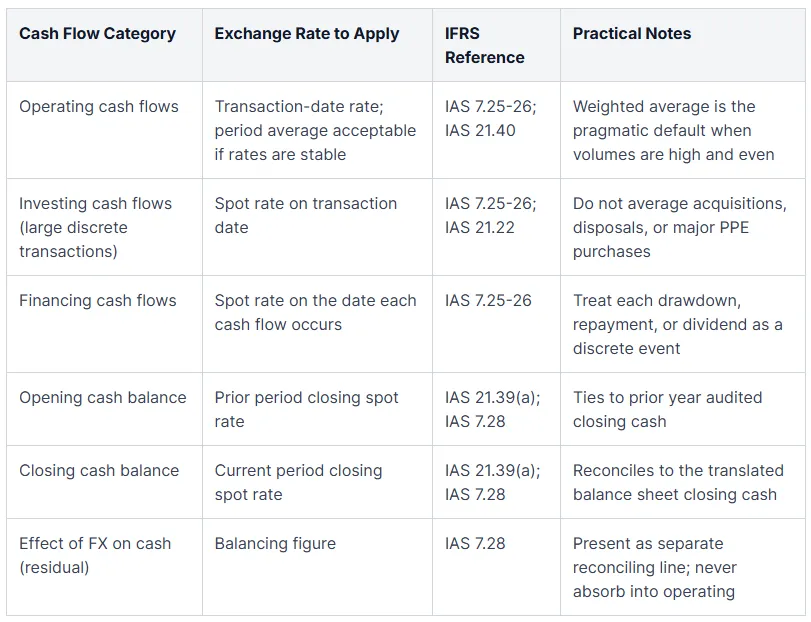
The rate you apply depends on the nature of the cash flow, not the location on the statement. Operating cash flows are high-frequency and reasonably even across a period, so a weighted average rate is usually a defensible approximation of transaction-date rates. IFRS for SMEs Module 30.18(b) reinforces the same principle for income and expenses.
Investing cash flows behave differently. A property acquisition, an equity investment, a disposal of a business unit: these are large, discrete transactions. Averaging them smooths away the actual rate that applied on the day cash moved, and the resulting figure is neither the transaction-date amount nor a faithful average. ICAEW guidance is explicit that large discrete items should be translated at the transaction-date rate.
Financing cash flows follow the same logic as investing. Loan drawdowns, loan repayments, dividends paid, share issues: each occurs on an identifiable date and should be translated at the spot rate that day. Where a facility draws down in tranches, each tranche is a separate cash flow with its own rate.
Opening and closing cash balances use closing spot rates at the respective statement of financial position dates. The opening balance is translated at the prior period's closing rate, the closing balance at the current period's closing rate. The residual between translated movements and translated balances is not a plug. It is the effect of exchange rate changes on cash and cash equivalents, and it belongs on its own line as a reconciling item.
One policy discipline matters more than any single rate choice. Document the rate selection method for each category, apply it consistently across reporting periods, and disclose the approach. Auditors will test consistency before they test elegance.
Why You Cannot Derive the Cash Flow Statement from a Translated Balance Sheet and P&L
There is a shortcut most preparers reach for at least once. Translate the balance sheet, translate the P&L, then back out cash flow movements from the translated figures. It looks mathematically clean. It is wrong under IFRS, and the wrongness is baked into the rate mechanics themselves.
IAS 21 paragraph 39(a) requires assets and liabilities of a foreign operation to be translated at the closing rate. Paragraph 39(b) requires income and expenses to be translated at transaction-date rates, or an average when appropriate. Paragraph 39(c) then dumps the resulting exchange difference into other comprehensive income, where it accumulates in the foreign currency translation reserve.
That FCTR is the fingerprint of the mismatch. Its existence proves that the translated balance sheet and translated P&L are on different rate bases. Any movement you derive by subtracting an opening translated balance from a closing translated balance carries a rate-change component that was never a cash movement. Push that into operating cash flow and you have quietly overstated or understated operating cash generation. Push it into investing or financing and you have distorted the very metrics analysts use to judge capital allocation.
IAS 7 paragraph 28 closes the door on this. Unrealised gains and losses from changes in foreign exchange rates are not cash flows, though the effect of exchange rate changes on cash and cash equivalents is presented separately to reconcile opening and closing cash. Read together, IAS 7.25, 7.26, and 7.28 form a closed system: translate each cash flow at its own rate, then let the residual FX effect sit on a dedicated reconciling line.
The common failure mode is netting the FX effect into operating cash flows to make the statement foot. It foots. It also misrepresents operating performance and rarely survives audit scrutiny. The correct treatment is boring, transparent, and defensible. Translate at the date of the cash flow. Isolate the FX effect. Reconcile openly. For teams standardising rate policy across a group, our resources on rate consistency go deeper into the operational discipline required.
Worked Example: Translating a Foreign Subsidiary's Cash Flow Statement Step by Step
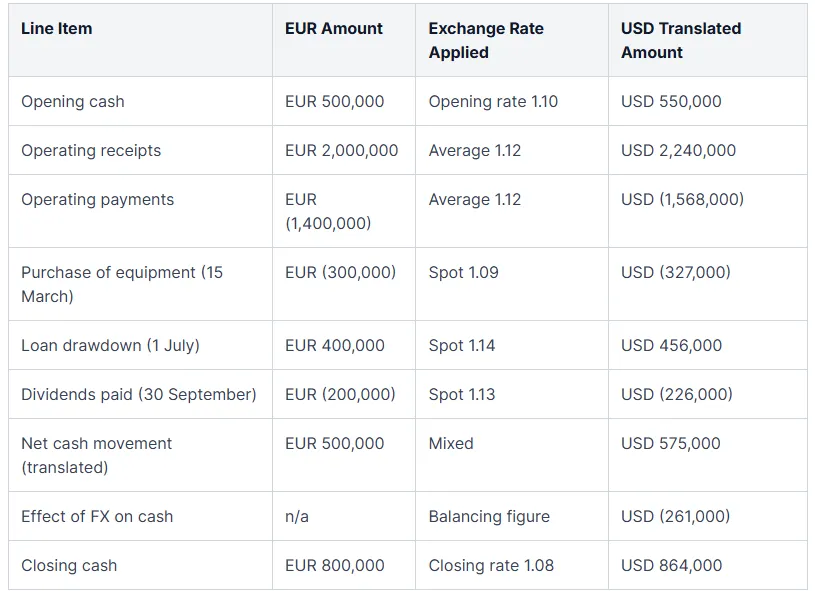
Walk through EuroSub Ltd, a EUR functional currency subsidiary of a USD reporting parent, for the year ended 31 December 2026. The mechanics matter more than the numbers. Each line gets its own rate.
Opening cash sits at EUR 500,000, translated at the opening rate of 1.10 to give USD 550,000. Operating receipts of EUR 2,000,000 flow through at the average rate of 1.12, landing at USD 2,240,000. Operating payments of EUR 1,400,000 use the same average rate. Equipment purchased on 15 March for EUR 300,000 gets the spot rate that day, 1.09. A loan drawdown on 1 July of EUR 400,000 translates at spot 1.14. Dividends paid on 30 September of EUR 200,000 use spot 1.13. Closing cash of EUR 800,000 lands at the closing rate 1.08, giving USD 864,000.
The subsidiary's cash flow statement is prepared in EUR first, then translated line by line into USD using transaction-date or appropriate average rates, per ICAEW technical guidance on subsidiary translation. This is the sequencing the profession expects: entity-currency preparation, then translation, then aggregation, then intra-group elimination. A professional training resource sets out the same four-step process.
The balancing figure at the bottom is not plugged. It is derived. The formula is straightforward:
FX effect on cash = Closing cash in reporting currency − Opening cash in reporting currency − Sum of translated cash movements.
For EuroSub, translated net cash movement is USD 314,000. Opening plus movements gives USD 864,000. Closing is USD 864,000. FX effect on cash is nil in this stylised example, but in practice this line is rarely zero and captures the retranslation of cash balances at closing rate. It sits as a separate line at the bottom of the statement per IAS 7.28. For a deeper walkthrough of the rate choices behind each line, the resource on consolidation rate selection is a useful companion.
The Effect of Exchange Rate Changes on Cash Line and Its Link to FCTR
The line labelled effect of exchange rate changes on cash and cash equivalents is not a cash flow. It is a reconciliation figure. It is the amount required to bridge translated opening cash, translated cash movements during the period, and translated closing cash.
IAS 7 paragraph 28 requires this effect to be reported separately in the statement of cash flows so that opening and closing cash reconcile cleanly. It sits outside operating, investing and financing activities. Treating it as any of the three misrepresents the underlying transactions and inflates or deflates category subtotals.
The link to FCTR is where finance teams often get confused. The foreign currency translation reserve captures all translation differences that arise when consolidating a foreign operation: on net assets translated at closing rate, on income and expenses translated at average or transaction rates, and on the opening equity carried forward. IFRS for SMEs Module 30.18(a) confirms the closing-rate treatment for cash and other monetary balances at each reporting date.
The FX effect on cash line is the slice of that broader translation movement attributable specifically to cash and cash equivalents. It is not a separate reserve. It is a presentation item in the cash flow statement, while the corresponding equity movement flows through OCI into FCTR under IAS 21.39(c).
Intragroup cash flows in foreign currencies must be eliminated on consolidation. That elimination is straightforward for the cash movements themselves. What remains, and what preparers frequently miss, is that translation differences on those intragroup balances stay inside FCTR. The cash flow eliminates. The reserve does not. (IAS 7 paragraph 28)
Frequently Asked Questions
Can I use the average exchange rate for all cash flows under IFRS?
No. IAS 21.40 permits an average rate only as a practical approximation, and only where rates do not fluctuate significantly during the period. Material discrete investing and financing transactions, such as acquisitions, disposals, equipment purchases, or loan drawdowns, should be translated at the spot rate on the transaction date. Applying a blanket average to everything distorts investing and financing subtotals and typically fails audit scrutiny.
Why is deriving the cash flow statement from the translated balance sheet incorrect under IFRS?
Because the translated balance sheet uses closing rate while the translated income statement uses average rate. The movement between them therefore contains non-cash translation differences that belong in FCTR, not in operating, investing, or financing activities. IAS 7.28 explicitly excludes unrealised FX gains and losses from cash flows. Deriving the statement from balance sheet movements pulls those unrealised amounts into cash flow categories and misstates the story.
How do I calculate the 'effect of exchange rate changes on cash and cash equivalents' line?
Use the formula: Closing cash in reporting currency minus opening cash in reporting currency minus the sum of translated cash flow movements. The result is a balancing figure. It is presented as a separate line at the bottom of the statement per IAS 7.28 and reconciles opening to closing cash without touching the three activity categories.
How are intragroup cash flows in foreign currencies treated on consolidation?
Intragroup cash flows must be eliminated in the consolidated statement of cash flows so the group only reports movements with external parties. However, translation differences arising on those intragroup balances remain within the foreign currency translation reserve in OCI. Eliminating the cash movement does not eliminate the historical translation difference sitting in equity.
Can a group apply cash flow hedge accounting to foreign currency exposures affecting the cash flow statement?
Yes. Under IFRS 9, a group can designate cash flow hedge relationships for highly probable foreign currency cash flows. The effective portion is recognised in OCI and reclassified to profit or loss when the hedged cash flow affects P&L. Hedge accounting does not change the underlying IAS 21 translation approach for the cash flow statement itself, but it does affect where gains and losses are presented.
What happens to cash flow translation when a subsidiary operates in a hyperinflationary economy?
IAS 29 applies first. The subsidiary's financial statements are restated for inflation using a general price index, and then all items, including comparatives, are translated at the closing rate under IAS 21.42. This overrides the standard mixed-rate approach in IAS 7 for that entity and requires careful disclosure of the restatement basis.
Automate IFRS Cash Flow Translation with Quick Consols
Manual cash flow translation across a multi-entity, multi-currency group is where spreadsheet chaos meets audit risk. Rates get pasted into the wrong cells. Spot dates get missed on material investing lines. The FX-on-cash line ends up as a plug rather than a derived figure. And nobody can trace how the number was built two months later.
Quick Consols removes that pain. The platform prepares each subsidiary's cash flow in its functional currency, applies the correct IAS 21 rates automatically (transaction-date, average, or closing as appropriate), aggregates translated line items, and calculates the effect of exchange rate changes on cash as a derived balancing figure. Intragroup cash flows eliminate automatically. FCTR movements flow through to equity with a clean audit trail. The consolidation cycle stops eating the second half of the month.
Finance teams running quarterly and annual close on complex multinational structures move from 15-plus day closes to something considerably tighter, with an audit-ready pack at the end of it.
If multi-currency consolidation is where your close breaks, see how Group Financial Consolidation in Quick Consols handles IFRS cash flow translation end to end. Book a demo and walk through your own structure with our team.

Share this Article


Get in Touch
If you have any questions about our Consolidation Software, send us a message below and we'll get back to you ASAP.
Read this next