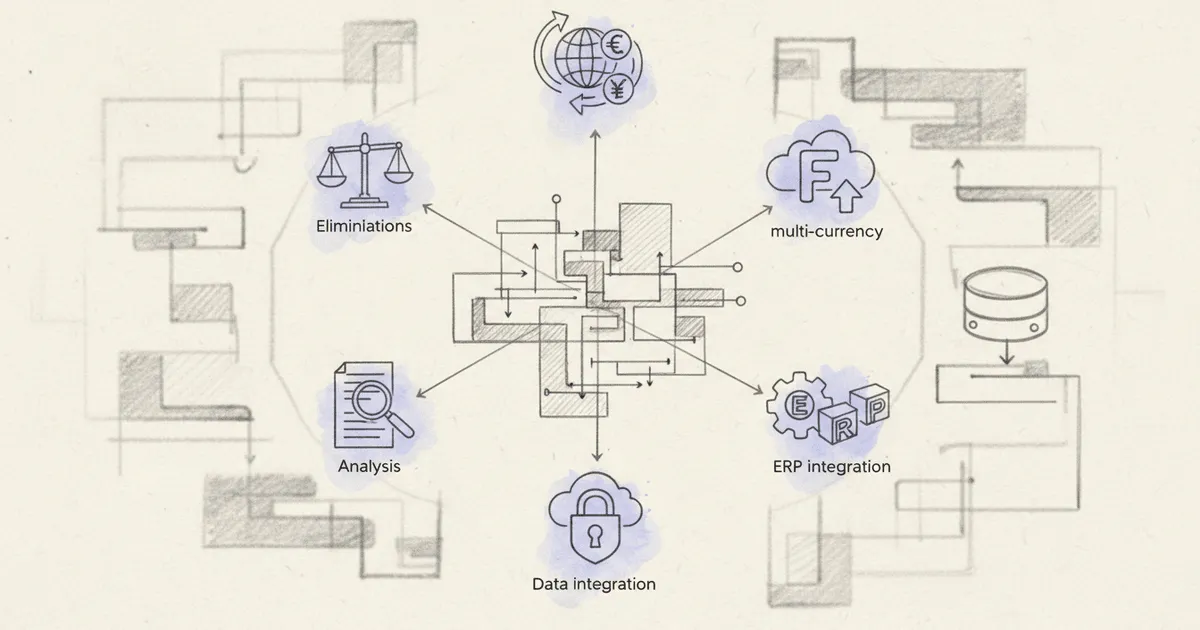
Top 5 Group Consolidation Challenges in Excel (And How to Fix Them)
Why Excel Still Dominates Group Consolidation (And Why That's a Problem)
Ask any group financial controller what tool runs their consolidation, and the honest answer is usually Excel. Not because it's the right tool. Because it's the one everyone knows.
That inertia has a cost. According to BARC's study of 267 European companies, 88% of finance teams with more than 10 legal entities report heavy reliance on Excel for group consolidation and reporting. The workbooks keep growing. So does the risk.
Each new subsidiary compounds the problem. Add a currency. Add an IFRS-to-US GAAP bridge. Add a minority shareholder. Suddenly a formula error in one tab quietly distorts the group financial statements downstream.
This piece walks through the five challenges that most consistently break spreadsheet-based consolidations: intercompany eliminations, multi-currency translation, minority interests and complex ownership, version control, and the audit trail. Each one is treatable with more Excel discipline. None are actually solved that way.
Group consolidation software isn't a productivity upgrade layered on top. It's a structural fix, a purpose-built ledger where multi-entity, multi-currency, and multi-GAAP logic lives natively instead of being simulated in cells.
Challenge 1: Intercompany Eliminations That Never Balance
Intercompany eliminations are where most spreadsheet consolidations quietly go sideways. On paper the concept is simple: what one subsidiary owes another must cancel out at group level. In practice, the tie-outs never quite tie.
BARC found that 57% of organizations with more than 5 subsidiaries perform intercompany eliminations primarily in spreadsheets. Manual matching across dozens of tabs is the norm. So are the mismatches.
The usual suspects show up every close. A sale booked in one entity's November, received in the counterparty's December. FX applied at different rates on either side of the transaction. A journal entry keyed to the wrong cost centre. Individually, small. In aggregate, an unexplained difference on the elimination worksheet that nobody wants to sign (BARC found that 57% of organizations) off.
Symptoms are predictable. Month-end drags on while group finance chases subsidiary controllers for confirmations. Reconciling schedules balloon. The last two days of the cycle get spent hunting a variance that turns out to be a rounding artefact.
Group consolidation software fixes this at the source. Automated matching engines pair intercompany balances by counterparty, currency, and period. Exception reports surface mismatches in real time, not at the end. Timing and FX gaps are flagged with the underlying transactions attached, so the fix path is obvious.
This is also where the difference between ERP-based consolidation and dedicated consolidation software becomes tangible. Teams weighing that decision often find useful context in a comparison of ERP versus purpose-built consolidation platforms before committing to an approach.
In a group running 25 or 30+ operating companies, the shift is dramatic. Manual reconciliation days per cycle collapse into automated exception queues, and the controller's job moves from data-chasing to actually reviewing the numbers.
Challenge 2: Multi-Currency Translation Errors and Broken FX Formulas
Multi-currency consolidation is the second place spreadsheets break. And it usually breaks silently.
BARC reports that 54% of multinational organizations rely on manually maintained FX rate tables in Excel. Someone updates the closing rate for December. Someone else forgets to update the average rate for the quarter. A cell reference points to the wrong month. The consolidated P&L still balances. It just balances at the wrong number.
IAS 21 is unforgiving on the mechanics. Balance sheet items translate at closing rate. P&L items at average rate for the period. Equity components at historical rate. Miss the distinction and the cumulative translation reserve absorbs an error that nobody can trace.
That's where the Foreign Currency Translation Reserve, or FCTR, becomes the graveyard of past mistakes. FCTR captures the accumulated gains and losses from translating subsidiary financials into the group's presentation currency. When Excel formulas drift, FCTR quietly balloons. Auditors notice. Explanations get thin.
Common failure patterns in spreadsheet FX:
- Closing and average rates swapped on the same worksheet
- Historical rates for share capital lost after a copy-paste
- Rate tables updated in one workbook but not the linked ones
- Rounding differences accumulating in the CTR without a clear source
Group consolidation software approaches this structurally. A centralized rate table feeds every entity, every period, every reporting layer. FCTR calculations run automatically against the correct rate type per line item. Every translated figure carries an audit-ready trail back to the source rate and the source transaction.
For teams that want a deeper look at how to handle FX translation without the recurring pain, this practical breakdown of FX consolidation mechanics covers the ground in detail.
The result: closing packs where the FCTR movement is explainable line by line, not a plug figure defended in the notes.
Challenge 3: Complex Ownership Structures, Minority Interests, and Step Acquisitions
Ownership structures are where Excel's tabular model finally admits defeat. A spreadsheet is a grid. A group is a hierarchy. The mismatch isn't a formatting problem, it's a modelling one.
BARC found that 47% of companies with tiered ownership structures of three or more levels use separate Excel workbooks per subsidiary to calculate NCI and goodwill. Each workbook a snapshot. Each snapshot outdated the moment a shareholding shifts.
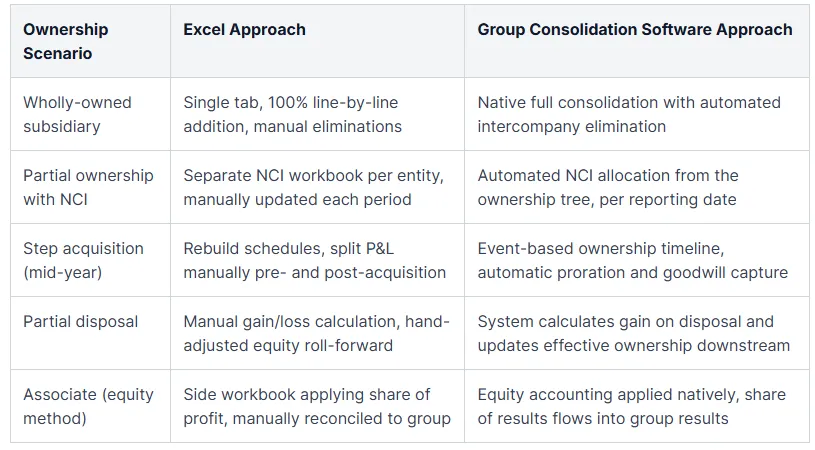
Non-controlling interests, partial disposals, step acquisitions, mid-year ownership changes: every one of these requires the calculation to know what percentage of what entity was held on what date. In Excel that becomes dozens of manually maintained schedules, one per subsidiary, one per reporting period, all linked by references that break the first time a tab is renamed.
IFRS 10 requires precise tracking of control changes. IFRS 3 demands fair value adjustments and goodwill allocation at each acquisition event. Neither standard cares that the finance team is doing this in workbooks emailed between offices.
Most guidance on this topic tells you to add more Excel controls. Validation macros. Locked cells. Named ranges. All useful hygiene, none of it addressing the actual problem. The structural mismatch between a two-dimensional grid and a multi-level ownership tree isn't fixed with better formulas. Adding validation on top of the wrong data structure just makes the wrong answer more consistent.
Group consolidation software resolves this by modelling entities the way they actually exist. A hierarchical tree where each node carries its effective ownership, acquisition date, fair value uplifts, and any ownership-change events on a timeline. NCI allocations flow automatically. Goodwill sits with the acquisition that generated it. When an ownership percentage changes mid-year, the system prorates by design rather than by manual override.
Step acquisitions and partial disposals are the clearest test. In Excel they require rebuilding the calculation each period. In dedicated software they're events on the entity timeline, and the group financials adjust without a rewrite.
Challenge 4: Version Control Chaos and the Single Source of Truth Problem
Ask a group accountant to open the folder where the consolidation lives. You'll see it. Consolidation_FINAL_v7_reviewed_updated.xlsx. Next to Consolidation_FINAL_v7_reviewed_updated_JS.xlsx. Next to the one from last Tuesday that somebody swore was the master.
It's a joke because it's universal. It's universal because the workflow is broken.
BARC reports that 59% of organizations without a dedicated consolidation system say they lack a single source of truth for group financial data. Subsidiary controllers email trial balances. Group finance pulls them into a master workbook. Someone at a subsidiary reruns their close, spots a misclassification, and sends a corrected TB two days later. That correction now has to be re-entered manually across the linked workbooks, the elimination tabs, the FX translation sheet, and the reporting pack.
Half the time it happens. Half the time an old figure survives into the group financials.
Cloud-based consolidation software collapses this problem. Every entity submits into one system. Permission controls decide who can edit what. When a subsidiary controller updates their trial balance, the group view refreshes automatically, not through a chain of copy-paste. Version control isn't a filename convention. It's built into the ledger.
The practical outcome is measurable. Quick Consols users reduce manual work by up to 4 days per close cycle, largely because the re-entry loop disappears. The group accountant stops being a data courier and starts being a reviewer.
One system. One version. One number the auditors can trace end to end.
Challenge 5: Audit Trail Gaps That Fail External Review
Auditors don't just want the consolidated number. They want to trace it. From the group figure, back to the elimination, back to the FX translation, back to the source trial balance in the subsidiary's ledger. That path is the audit trail. And Excel doesn't have one.
Spreadsheets record the current state of a cell. They do not record who changed it, when, or why. A revenue elimination edited three days before sign-off looks identical to one entered in month one. Documentation of elimination rationale, translation rates applied, and ownership changes typically lives across emails, shared folders, and someone's memory. When the auditor asks for it, the scramble begins.
The deeper issue is time. Finance teams already spend the majority of the close on data collection and rework. Control documentation becomes the thing that gets skipped, then reconstructed under pressure during audit fieldwork. That reconstruction is where qualified opinions and management letter points quietly originate.
Dedicated group consolidation software closes the gap. Every posting, elimination, and rate change carries an immutable log: user, timestamp, before-and-after values. Consolidated figures drill down to the source transaction in one click. Reviewer sign-off workflows enforce segregation of duties before numbers move to the next stage. The audit file assembles itself as the close progresses, not after. For a deeper look at where these gaps typically originate, our audit-readiness resources walk through the common failure patterns.
How to Know When It's Time to Move Off Excel
There is no single moment when Excel stops working. It erodes. The close takes an extra day, then two. A new subsidiary joins the group. A currency gets added. An auditor flags a control weakness. Each event on its own is manageable. Together, they signal the tool has run out of room.
The trigger signals worth watching:
- More than 5 entities in the group
- Two or more reporting currencies
- Monthly consolidation taking longer than 5 days
- Recent audit findings on consolidation controls
- Key-person risk: only one or two people understand the master workbook
If three or more apply, the case for dedicated software is already made. BARC's research found that 49% of finance teams that moved to a dedicated consolidation system reported a 30-50% reduction in group close time within the first year. The ROI picture is similar: small and medium businesses adopting consolidation software achieve an average annual ROI of 50-150% within the first three years, with payback typically inside 12 months.
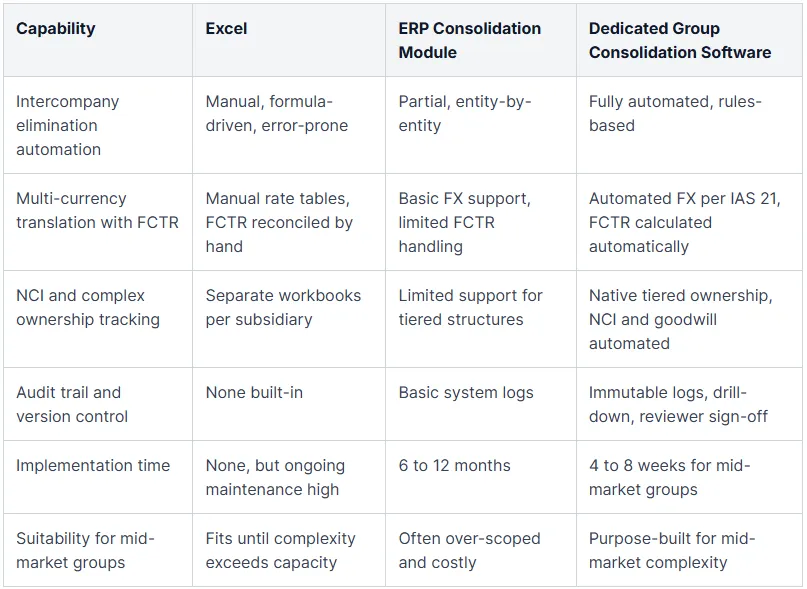
Implementation is more approachable than most controllers expect. Mid-market groups typically onboard in 4 to 8 weeks, not the multi-quarter enterprise timelines that give consolidation software a heavy reputation. For teams weighing whether their current accounting stack can stretch further, our comparison of general ledger tools versus dedicated consolidation platforms sets out where the line sits.
Frequently Asked Questions
What is group consolidation software and how is it different from financial consolidation software?
Group consolidation software is built specifically for multi-entity ownership hierarchies. It handles non-controlling interests, goodwill, tiered structures, and IFRS 10 and IFRS 3 requirements natively. Generic financial consolidation tools often stop at aggregating trial balances across entities, leaving the group-accounting mechanics (NCI, partial consolidations, associate equity accounting) to be handled outside the system. For groups with real ownership complexity, that distinction is the difference between a clean close and a rebuilt one.
Can group consolidation software handle multiple currencies?
Yes. Dedicated group consolidation software automates foreign currency translation per IAS 21, applying closing rates to balance sheet items, average rates to the income statement, and historical rates to equity. The foreign currency translation reserve (FCTR) is calculated automatically and reconciled every cycle. Compared with manually maintained FX rate tables in Excel, which are prone to stale rates and formula breaks, automated translation removes an entire category of restatement risk.
How long does it take to implement group consolidation software?
Mid-market groups with 5 to 25 entities typically onboard in 4 to 8 weeks. Larger enterprise groups with layered ownership, multiple reporting standards, and legacy ERP integrations can run 3 to 6 months. Cloud-based platforms shorten timelines significantly compared with on-premise enterprise systems, because there is no infrastructure build. The main variables are chart-of-accounts standardization, opening balance validation, and the availability of finance team time during the build.
Is group consolidation software suitable for mid-market or SME groups?
Yes, and this is where mid-market groups often get underserved. Enterprise consolidation platforms are priced and scoped for the largest multinationals, which pushes smaller groups back into spreadsheets by default. Cloud-based group consolidation software built for mid-market complexity closes that gap: it handles multi-entity, multi-currency, tiered ownership consolidations without an enterprise price tag or a year-long implementation.
Does group consolidation software integrate with Xero, QuickBooks, and Sage?
Yes. Modern group consolidation platforms integrate directly with Xero, QuickBooks, Sage, and most major ERPs. Trial balances are pulled automatically on a scheduled or on-demand basis, mapped to the group chart of accounts, and made available for consolidation without manual exports or CSV reformatting. This removes the copy-paste layer that generates most of the reconciliation errors in spreadsheet-based groups.
Will group consolidation software improve our audit outcomes?
Yes. Immutable audit trails record who posted every journal, elimination, and rate change, with timestamps and before-and-after values. Consolidated figures drill down to the source transaction in the subsidiary ledger. Documented controls for eliminations, currency translation, and ownership changes give auditors the evidence trail they ask for. The audit file effectively assembles itself as the close progresses, rather than being reconstructed under pressure during fieldwork.
Read how Ubora Group solved these in practice
Ready to Fix Your Group Consolidation Process?
Staying in Excel is rarely a decision. It's a default that compounds. Every close absorbs another day. Every new entity adds another workbook. Every audit cycle adds another round of retro-documentation. The cost shows up in overtime, staff turnover, delayed board reporting, and audit findings the team knew were coming but didn't have hours to prevent.
A generic ERP module rarely fixes it either. Group accounting mechanics (NCI, FCTR, partial consolidations, IFRS and US GAAP dual reporting, segmental reporting across cost centres and profit centres) need a tool designed for them, not bolted onto a transactional system.
Quick Consols is purpose-built for group consolidations. Automated intercompany eliminations, multi-currency translation with FCTR handled correctly, tiered ownership and NCI calculated natively, an immutable audit trail, and a single source of truth for the group. Cloud-based, unlimited users, month-to-month.
If the last five closes have felt harder than the five before them, that trend does not reverse on its own. See how Group Financial Consolidation works on your actual entity structure, or book a demo and walk through your current pain points with the team.

Share this Article


Get in Touch
If you have any questions about our Consolidation Software, send us a message below and we'll get back to you ASAP.