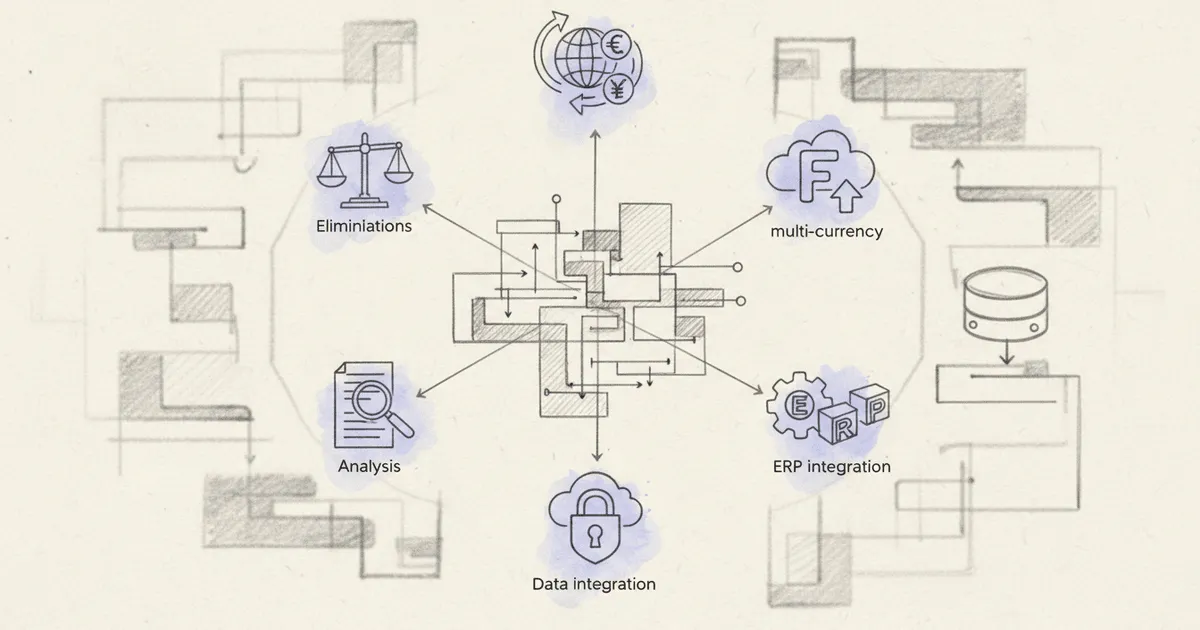
The Ultimate Guide to Financial Consolidation Software in 2026
Why Financial Consolidation Software Matters in 2026
Finance teams still lose four or more days every month to manual consolidation. Spreadsheets crash. Formulas break. Someone re-keys a trial balance at 11pm before the board pack goes out. This is the reality most controllers manage in silence, and it hasn't changed much despite decades of ERP investment.
2026 is the year that changes. AI-powered consolidation platforms have moved from vendor demos to production workflows. Automated intercompany eliminations, agent-based close, anomaly detection on trial balance imports, real-time multi-currency translation. The tooling has caught up to what finance teams have been asking for. Automation now compresses close cycles by 50%-70% and cuts labor costs by 20%-35% when deployed properly.
This guide is for the people carrying the group close: CFOs, financial controllers, group accountants, and finance managers running multi-entity, multi-currency structures. Whether you're a mid-market group with eight subsidiaries or an enterprise with a hundred, the fundamentals of choosing the right platform are the same.
Here's what we cover:
- What financial consolidation software actually is, and how it differs from your ERP
- The core features that separate serious platforms from spreadsheet replacements
- The top 10 tools in 2026, including Gartner Magic Quadrant positioning
- How the software improves accuracy and kills manual re-keying
- Multi-currency, multi-entity, FCTR, NCI, and equity accounting handled cleanly
- Buyer criteria, implementation timelines, and answers to the questions finance teams ask before signing
Read it end to end, or jump to the section that matches where you are in the buying cycle.
What Is Financial Consolidation Software?
Financial consolidation software is a specialized platform that pulls trial balances from multiple legal entities, applies group accounting rules, and produces one consolidated set of financial statements. According to Fathom, it combines financial data from multiple legal entities, subsidiaries, or business units into one consolidated set of statements. That's the plain-English definition.
The purpose is narrower and deeper than general accounting. Gartner defines financial close and consolidation solutions as applications that enable CFOs and their teams to manage group close, consolidation, and reporting processes. Consolidation software automates the mechanics that spreadsheets punish you for: (Gartner defines financial close and consolidation solutions) intercompany eliminations, foreign currency translation, minority interest allocations, segmental reporting, and audit-ready workpapers.
How it differs from ERP and accounting software. Your ERP records transactions. Xero, QuickBooks, Sage, NetSuite. They handle the operational ledger for each entity. Consolidation software sits above that layer. It's positioned as a specialized layer that works on top of the ERP, not a replacement for it. The trial balance leaves the ERP. Group accounting rules get applied inside the consolidation engine. Consolidated statements come out the other end.
Most ERPs offer a consolidation module. In practice these modules struggle once you have mixed accounting systems across subsidiaries, changing ownership percentages, or IFRS-versus-local-GAAP reporting requirements. That's the point where teams look for dedicated software.
Who actually uses it. Group financial controllers own the day-to-day. CFOs care about the output, the audit posture, and the close calendar. Group accountants run the elimination journals and the FCTR calculations. Finance managers in operating subsidiaries load their trial balances and answer intercompany queries. Every one of these roles benefits from a single source of truth instead of a shared drive full of workbooks.
Common triggers for adopting it. Acquisitions are the most common. The moment a business buys or merges with another entity, spreadsheet consolidation starts breaking. Foreign subsidiaries add currency translation and FCTR complexity. An audit finding on manual controls forces the conversation. IFRS or US GAAP compliance requirements, especially IFRS 16 lease accounting or IFRS 3 business combinations, tip the scales. Many teams reach for automation only after a painful year-end close makes the case for them.
If any of that sounds familiar, dedicated Group Financial Consolidation software is worth a serious look.
What Are the Key Features of Financial Consolidation Software?
Not every platform sold as consolidation software actually consolidates. The 7 Features That Define Good Consolidated feature set below is the real bar. Anything less is a reporting tool with a marketing budget.
- Multi-entity consolidation. Roll up an unlimited number of subsidiaries into group results, with support for tiered ownership, sub-groups, and partial consolidations.
- Intercompany eliminations. Automated removal of reciprocal intercompany transactions before group statements are finalized, so revenue, receivables, and payables aren't double-counted.
- Multi-currency translation. Convert entity-level balances into the reporting currency using closing, average, and historical rates, with FCTR posted automatically.
- Automated close workflows. Task assignments, validations, and approvals that replace email chains and shared checklists.
- Audit trails. Every journal, adjustment, and approval preserved with review history and change logs for audit readiness.
- IFRS/GAAP compliance. Support for IFRS, US GAAP, and local frameworks, including SOX-related controls where relevant.
- ERP integrations. Direct connections to Xero, QuickBooks, Sage, NetSuite, SAP, and Oracle to pull trial balances without manual exports.
- Real-time reporting. Current visibility into consolidated performance across entities and currencies, not a snapshot that's already stale.
Any serious vendor should tick all eight. The differentiator in 2026 is AI. Anomaly detection on trial balance imports flags unusual movements before they hit the group ledger. Automated journal suggestions propose the elimination or reclassification entry based on prior period patterns. Agent-based close tools can chase missing intercompany confirmations without a human in the loop.
Compliance isn't optional. If a platform can't produce IFRS-compliant group statements out of the box, it's a spreadsheet with a database attached. IFRS 16 lease treatment, IFRS 3 goodwill and NCI calculations, and segmental reporting under IFRS 8 should all be handled natively. The 7 Features That Define Good Consolidated statements software is a useful checklist to run alongside your shortlist.
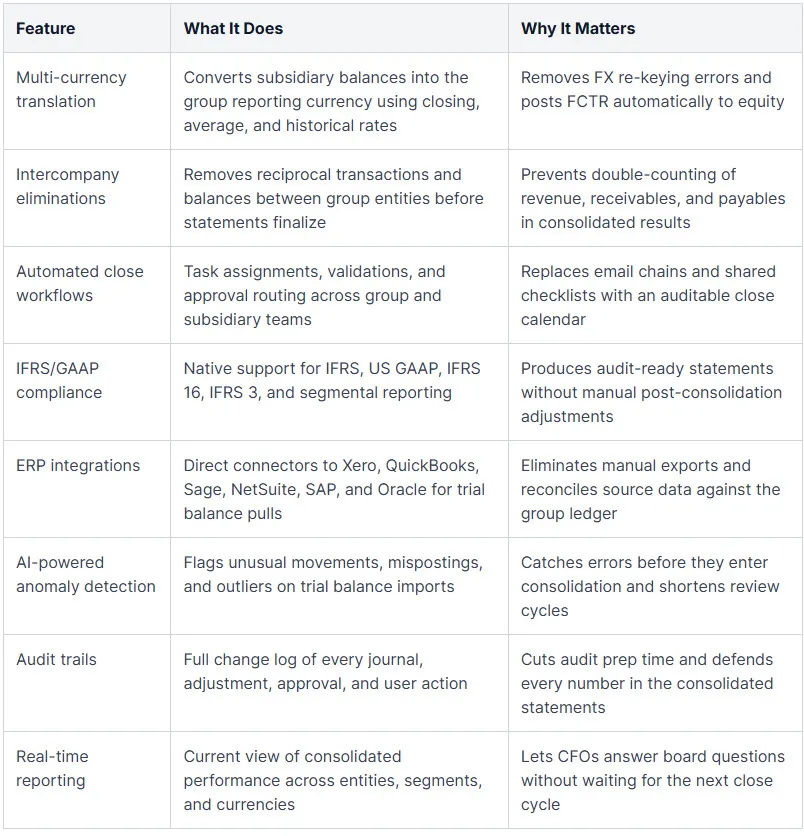
The table below summarizes what each feature does and why finance teams care.
The Top 10 Financial Consolidation Software Tools in 2026
The financial consolidation market splits cleanly into three tiers in 2026: enterprise CPM suites, mid-market platforms, and SMB or scale-up tools. The Gartner Magic Quadrant for Financial Close and Consolidation Solutions is the most-cited reference for enterprise positioning, and Anaplan confirms its 2026 recognition alongside vendors like OneStream, Oracle, and Wolters Kluwer.
Here's how the top 10 stack up.
- Quick Consols. Cloud-based consolidation software built for finance teams running complex multi-entity, multi-currency groups. Integrates with Xero, QuickBooks, Sage, and other ERPs. Strong on automated intercompany eliminations, FCTR handling, and annual financial statements. Best for mid-market groups that want enterprise-grade output without an 18-month implementation.
- OneStream. Positioned as an enterprise CPM suite for complex consolidation, planning, and reporting. Unified platform covering close, planning, and reconciliations. Preferred by large groups with heavy corporate performance management requirements.
- HighRadius. Enterprise finance automation suite that includes consolidation-adjacent financial close functionality. Positioned as a Challenger in the 2026 Gartner Magic Quadrant, with strength in AI-driven close acceleration.
- Workiva. Strong on connected reporting, disclosure management, and ESG reporting alongside consolidation. Popular with listed companies that need SEC or IFRS filing workflows.
- Prophix. A mid-market-oriented platform frequently listed among 2026 consolidation options, with balanced consolidation, planning, and reporting capabilities.
- Vena. Excel-native planning and consolidation platform. Suits finance teams that want to keep the Excel front end while gaining a database and workflow layer behind it.
- Nominal. Newer entrant focused on multi-entity accounting automation. AI-first architecture aimed at high-growth groups needing rapid rollout.
- BlackLine. Best known for account reconciliation and close management. Consolidation capabilities are strongest when combined with its close and controls suite.
- Wolters Kluwer CCH Tagetik. Enterprise financial close and consolidation platform with compliance-oriented positioning. Deep support for statutory reporting, IFRS, and regulatory frameworks.
- Oracle FCCS. Enterprise consolidation module inside the Oracle EPM cloud. Natural fit for organizations already standardized on Oracle ERP.
Which tier fits you. Enterprise CPM suites (OneStream, Oracle FCCS, CCH Tagetik) are built for global groups with hundreds of entities and dedicated FP&A teams. Mid-market platforms (Quick Consols, Prophix, Vena, Workiva, BlackLine, HighRadius) balance capability with faster deployment. Nominal and similar entrants target scale-ups that need to move fast without an enterprise implementation.
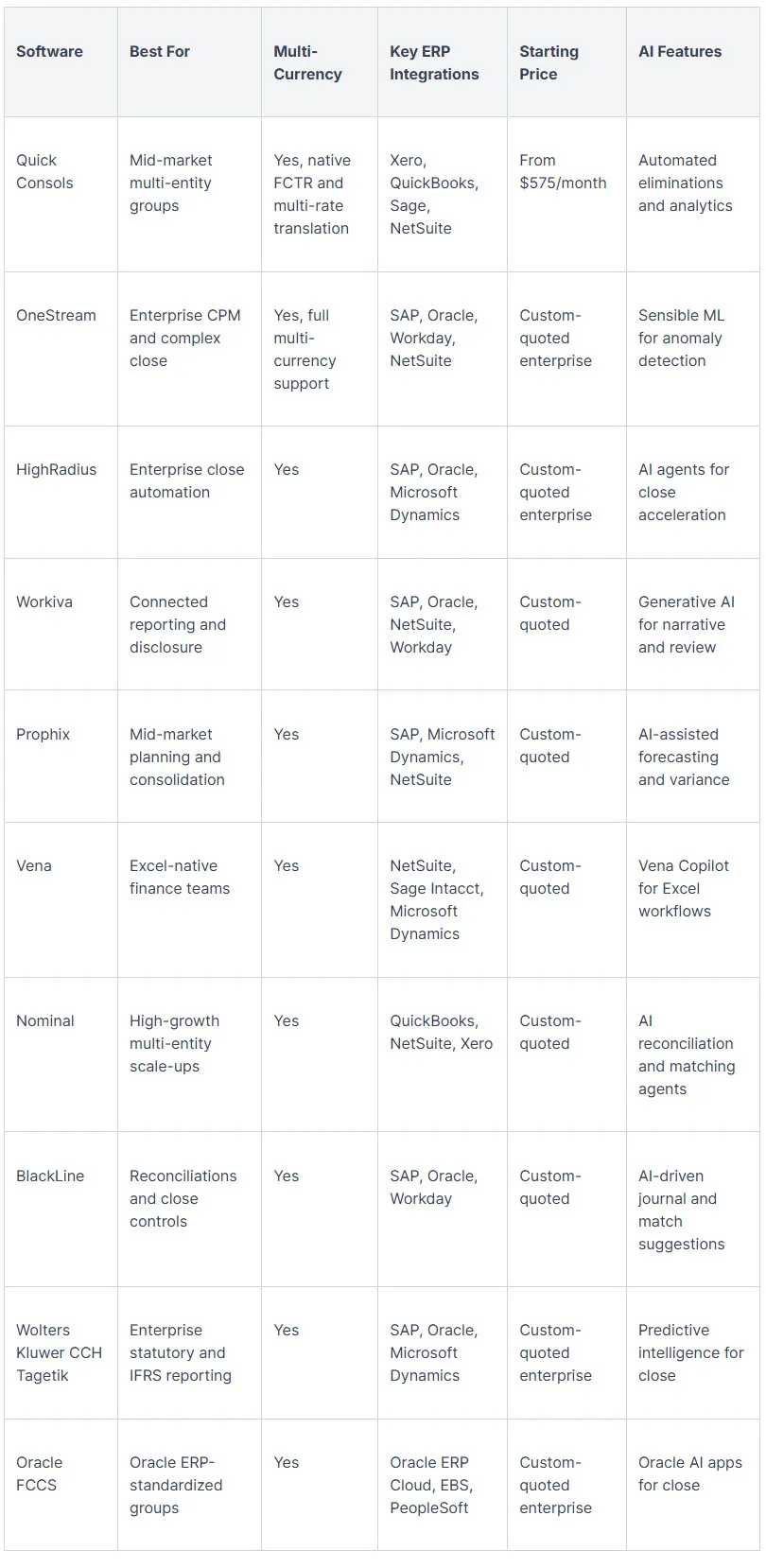
For a deeper walk-through of ranking methodology and buyer fit, see this Group Financial Consolidation practical guide. The comparison table below summarizes the shortlist.
How Does Financial Consolidation Software Improve Accuracy and Reduce Manual Effort?
Consolidation software improves accuracy by removing the two things that break spreadsheets: manual re-keying and formula fragility. Research going back to the Journal of End User Computing shows that 88% of spreadsheets contain errors. That statistic is quoted often for a reason. Every broken reference, every hard-coded exchange rate, every SUMIF that missed a row is a candidate for an audit adjustment.
Automated intercompany eliminations kill the biggest source of double-counting risk. When Entity A sells to Entity B, the revenue and receivable on one side must exactly match the cost and payable on the other. Automated consolidation removes reciprocal intercompany transactions before group statements are finalized, reducing the risk of double-counting. Reciprocal balances net to zero automatically, and the platform flags the mismatches instead of the group accountant hunting for them at midnight.
Version control replaces email chains. In a spreadsheet workflow, there are usually five versions of "Consolidation_Master_FINAL_v3.xlsx" floating between the group accountant, the audit partner, and the CFO. In consolidation software, one dataset is live. Every change is logged with a user, a timestamp, and a reason. Audit prep stops being an archaeological dig.
Real-time validation catches errors before the auditor does. Trial balance imports validate against the chart of accounts on load. Intercompany mismatches surface at the elimination stage, not at review. Currency translation posts FCTR to equity in the same run, so translation differences never disappear into a rounding cell.
Consider a mid-market group with a 15-day close cycle running eight subsidiaries across three currencies. Automation of that same close on a dedicated platform can compress it toward five days without adding headcount, in line with published reductions of 50%-70% and labor savings of 20%-35%. The finance team stops firefighting and starts analyzing. The auditor gets a clean workpaper pack. The CFO gets numbers earlier in the month.
That's the accuracy story in practical terms. Fewer errors. Fewer people needed to catch them. Faster close.
Can Financial Consolidation Software Handle Multiple Currencies and Entities?
Yes. Dedicated consolidation software is purpose-built for multi-currency, multi-entity groups. That's the entire point of the category. According to WiFiTalents, financial consolidation software handles multi-entity roll-ups and currency translation as core functions, and Fathom describes the same standard capability across the leading platforms. (According to WiFiTalents)
FX translation methods. Under IFRS and US GAAP, different line items translate at different rates. Assets and liabilities translate at the closing rate. Income statement items translate at the average rate for the period. Equity and historical transactions translate at historical rates. Good consolidation software applies each rate to the correct line automatically. You set the rate table once. The engine does the rest.
FCTR and CTA handling. The foreign currency translation reserve, sometimes called cumulative translation adjustment, catches the residual translation differences that arise from using different rates across the balance sheet, income statement, and equity. Consolidation software calculates FCTR on every run and posts it to other comprehensive income without manual intervention. This is where spreadsheet consolidations tend to break down, and it's the specific problem that Financial Consolidation Software 8 Ways to fix multi-entity close is worth reading on.
Unlimited entities and tiered ownership. Real group structures aren't flat. You have sub-groups, holding companies, dormant entities, and partial ownership chains. Consolidation software supports tiered roll-ups, so a sub-group consolidates first and then flows into the top-level parent. Non-controlling interests get calculated at each level using the effective ownership percentage.
Joint ventures and associates. Not everything gets fully consolidated. Associates typically use equity accounting, where the group's share of profit flows through a single line rather than line-by-line consolidation. Joint arrangements may use equity accounting or proportionate consolidation depending on the structure. A serious platform handles partial consolidations, equity pickups, and JV treatments natively, without a workaround.
If your group has more than three currencies or more than five entities, this is exactly the category of problem consolidation software solves. Spreadsheets can approximate it. They can't scale it.
Best Financial Consolidation Software for SMBs and Mid-Market Groups
The conventional wisdom says consolidation software is for large enterprises with 50 subsidiaries and a dedicated FP&A bench. That's backwards. Smaller groups usually get more value per dollar because they don't have the headcount to brute-force a close in Excel. One controller. Three subsidiaries. Two currencies. That's the finance team that bleeds the most days per month.
Modern cloud-based platforms have collapsed the price-of-entry problem. SMB and mid-market groups can now access automated intercompany eliminations, foreign currency translation, and segmental reporting at pricing that would have bought a single seat of enterprise CPM five years ago. The economics have flipped.
What growing businesses should look for:
- Native integration with Xero, QuickBooks, and Sage so trial balance imports don't require middleware
- Quick setup measured in weeks, not quarters. Excel-native platforms can go live in 4 to 6 weeks according to Datarails
- Transparent pricing on the vendor's website, not a mandatory sales call before you see a number
- No compulsory consultants to build your first consolidation
- Unlimited users so subsidiary accountants can input directly without per-seat penalties
- Support for partial consolidations, NCI, FCTR, and multi-GAAP reporting out of the box
Warning signs the tool is wrong for your group: a 6-month implementation quote, per-user licensing that stacks fast as subsidiary controllers get added, and mandatory professional services attached to every configuration change. Mid-market platforms typically take 3 to 6 months to implement depending on entity count and data sources, per Datarails, which is fine for a 30-entity group. It's overkill for a 5-entity group that closes monthly.
For growing groups with 2 to 25 entities, the shortlist looks different than what you'll see in analyst rankings. Look for platforms built cloud-native from day one, priced for finance teams rather than IT budgets, and designed so a single controller can own the consolidation cycle without a project manager. A deeper breakdown of specific vendors sits in our roundup of the 10 best consolidation tools for growing groups.
The honest answer is that most SMB and mid-market groups don't need enterprise CPM. They need a single source of truth, audit-ready outputs, and a platform that eliminates the spreadsheet chaos. That's a different product category. Pick accordingly.
How to Migrate from Excel to Financial Consolidation Software
Excel doesn't fail dramatically. It fails slowly, one broken link at a time, until the month-end close stops being reliable. If you recognize the signs, it's time to move.
Signs Excel has broken:
- Consolidation takes more than 5 days each month
- Two or more people edit the same master workbook, and version control becomes a Slack thread
- FX translation errors surface during audit review
- Intercompany balances don't eliminate cleanly, and the plug goes into a suspense account nobody owns
- Auditors flag control weaknesses around spreadsheet integrity
- Adding a new subsidiary means rebuilding tabs from scratch
Any two of these together means the spreadsheet has outlived its usefulness. Three means you're carrying real audit risk.
The migration path, step by step:
- Audit the current process. Document every workbook, every macro, every manual adjustment. Time each step. This becomes your baseline for ROI later.
- Map entities and chart of accounts. List every legal entity, its functional currency, its GAAP basis, and any partial consolidations or NCI positions. Standardize the group chart of accounts before you touch software.
- Clean trial balances. Reconcile opening balances. Resolve suspense accounts. Document intercompany relationships so eliminations can be automated on day one, not retrofitted later.
- Select software. Match the tool to your entity count, currency complexity, and reporting standards. Don't buy enterprise CPM for a 6-entity group.
- Run a parallel close. Consolidate one month in both Excel and the new platform. Reconcile the differences. Fix the source data or the configuration until the numbers tie.
- Cutover. Retire the master workbook. Archive it for audit history, then stop editing it.
Change management is where migrations quietly go sideways. Subsidiary accountants who have owned their tab in the master workbook for years don't automatically welcome a new system. Train them early. Give them read access before write access. Show them how the platform eliminates the reconciliation emails they currently field at month-end. Buy-in follows utility.
Phased rollouts work better than big-bang cutovers for groups with more than 10 entities. Start with the largest three subsidiaries, then add the rest in waves.
Realistic timeline: 4 to 12 weeks for most mid-market groups, depending on entity count, chart of accounts standardization, and how clean the opening trial balances are. Groups that skip the data preparation stage always run long. Groups that invest two weeks in cleaning up the source data usually go live on schedule.
Implementation Timeline, Total Cost of Ownership, and ROI
Implementation timelines vary more with entity count and data quality than with vendor selection. Buyers who understand the segment they sit in avoid two expensive mistakes: over-buying enterprise CPM for a small group, or under-buying a scale-up tool that hits its ceiling in 18 months.
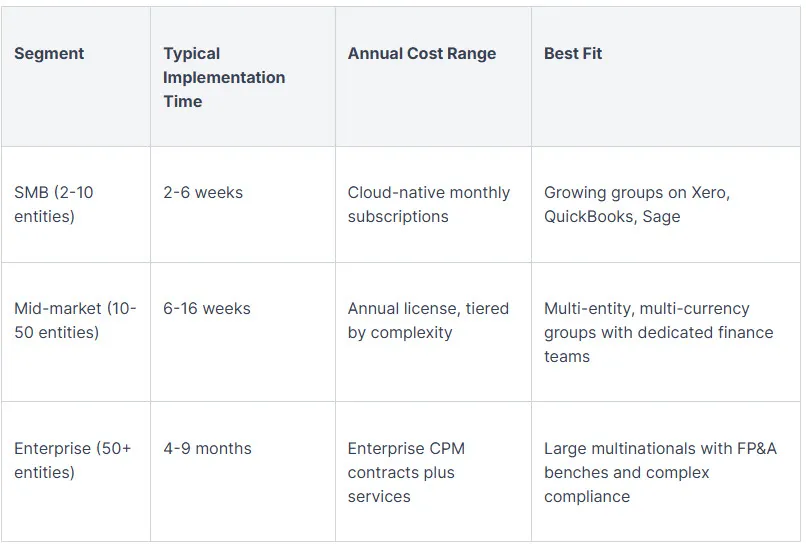
SMB deployments move fastest. An Excel-native or cloud-native implementation can go live in 4 to 6 weeks when the group runs on Xero, QuickBooks, or Sage and the chart of accounts is already reasonably clean. Mid-market platforms typically take 3 to 6 months. Enterprise CPM suites can take 6 to 18 months and require dedicated project teams, according to Datarails, which is exactly why so many mid-market buyers walk away from that tier.
Total cost of ownership breaks into five buckets:
- License fees (annual or monthly)
- Implementation and configuration
- Training for finance teams and subsidiary users
- Ongoing support and version upgrades
- Integration costs for ERP and accounting system connections
License fees are the visible number. Implementation and integration usually cost more than the first year of licenses at the enterprise tier, and are often bundled into mandatory professional services. That's the line item to interrogate hardest during vendor selection.
Building a realistic ROI case is straightforward. Multiply hours saved per close by the fully loaded cost of the finance team, add audit fee reduction from cleaner trial balances and better audit trails, then factor in the strategic value of closing faster. A finance team recovering four days per month is recovering roughly 48 days per year. That's a controller-equivalent of time redirected from consolidation mechanics to analysis.
Onboarding red flags to watch for:
- Rigid templates that can't accommodate your group's actual structure
- Mandatory consultants for every configuration change post go-live
- Unclear go-live criteria, so the project drifts
- No parallel close plan
- Training limited to admin users, leaving subsidiary accountants unsupported
Frequently Asked Questions About Financial Consolidation Software
What is the difference between financial consolidation software and ERP consolidation modules?
ERP consolidation modules handle basic roll-ups within a single ERP ecosystem, and they work reasonably well when every entity runs on the same instance. Dedicated consolidation software works across multiple ERPs and accounting systems, which is the reality for most groups that have grown through acquisition. It also handles complex intercompany eliminations, NCI, FCTR, and partial consolidations with purpose-built logic rather than bolt-on configurations. Group reporting, segmental analysis, and audit trails are first-class features rather than afterthoughts.
How long does it take to implement financial consolidation software?
SMB cloud tools typically go live in 2 to 6 weeks. Mid-market platforms take 6 to 16 weeks depending on entity count and chart of accounts complexity. Enterprise CPM suites run 4 to 9 months and sometimes longer when integration with multiple ERPs is involved. The single biggest driver of timeline is data quality on the source trial balances, not vendor selection.
Can financial consolidation software handle IFRS and US GAAP compliance?
Yes. Leading consolidation platforms support IFRS and US GAAP simultaneously, including IFRS 16 lease accounting, with configurable accounting policies at the entity level. Automated adjustments, dual-GAAP reporting, and audit-ready trails covering every change, review, and approval are standard features on any platform worth shortlisting. If a vendor cannot demonstrate multi-GAAP reporting during the demo, it's the wrong tool for a group with international entities.
How much does financial consolidation software cost in 2026?
Pricing varies by segment. SMB cloud tools typically run monthly subscription pricing designed for growing groups. Mid-market platforms move to annual licenses tiered by entity count and complexity. Enterprise CPM contracts sit meaningfully higher, and implementation, integration, and professional services often exceed the first year of license fees. Always ask for a total three-year cost, not just the year-one license figure.
Is AI actually useful in financial consolidation software?
AI adds real value for anomaly detection, automated journal suggestions, intercompany matching, and variance commentary generation. These are pattern-recognition tasks where machine learning outperforms rule-based logic. Core consolidation itself, however, still runs on deterministic accounting engines because auditors need reproducible logic they can trace. Treat AI as a productivity layer on top of a reliable consolidation engine, not as the engine itself.
Do I need consolidation software if I only have 2 or 3 entities?
At 2 or 3 entities with a single reporting currency and no intercompany trading, Excel can still work. As soon as multi-currency translation, intercompany balances, or external audit requirements enter the picture, the case for software becomes strong even at small entity counts. FX errors, formula fragility, and version-control chaos scale faster than most controllers expect. Most groups that wait until 8 or 10 entities to switch wish they had moved sooner.
Automate Your Group Consolidation with Quick Consols
Manual consolidation eats four or more days every month. That's time your finance team could spend on analysis, forecasting, and the questions the board actually cares about. Quick Consols automates the mechanical work: multi-entity roll-ups, foreign currency translation, intercompany eliminations, NCI, FCTR, and segmental reporting all handled inside one cloud-based platform.
The fit is strongest for mid-market and growing groups running on Xero, QuickBooks, or Sage. Trial balances flow in through native integrations. Group accounting rules apply automatically. Outputs are audit-ready under IFRS and US GAAP, with full audit trails and change history preserved for every review cycle. Unlimited users. Month-to-month pricing. No mandatory consultants to configure your first close.
Controllers who move off spreadsheet chaos onto a purpose-built platform typically recover up to 4 days per month, redirect that time to analysis, and stop dreading audit season. Subsidiary accountants get a single source of truth. CFOs get consolidated numbers they can defend.
If your close cycle has stretched past 5 days, if version control has become a Slack thread, or if audit findings are surfacing around spreadsheet integrity, the next step is a conversation. See how Group Financial Consolidation works for a group your size, and book a demo to walk through your actual entity structure with our team. Bring your trickiest intercompany balance. We'll show you how it resolves in the platform.

Share this Article


Get in Touch
If you have any questions about our Consolidation Software, send us a message below and we'll get back to you ASAP.