Multi-Entity Accounting Software: When Your Chart of Accounts Isn't Enough
Multi-Entity Accounting Software: When Your Chart of Accounts Isn't Enough
Stop trying to force five legal entities into a chart of accounts designed for one. The moment your group structure expands beyond a single company, that neatly organized GL becomes a tangle of sub-accounts, custom segments, and manual workarounds that slow down every close.
Multi-entity accounting software is a unified platform that centralizes the books of multiple subsidiaries, automates intercompany tasks, and delivers consolidated financial views from a single dashboard. For finance controllers managing three or more entities across jurisdictions, it replaces the spreadsheet chaos that a standalone chart of accounts was never built to handle.
According to Avantiico's 2025 analysis, organizations running multiple legal entities through a single chart of accounts face roughly three times more manual reconciliation errors than those using purpose-built multi-entity tools. That error rate compounds fast once you add foreign currencies, intercompany loans, and entity-specific compliance requirements.
This article breaks down six critical areas that determine whether your current multi-entity accounting software is still fit for purpose, or whether your group has outgrown it:
- Who actually needs this type of platform (and who's confusing it with departmental tracking)
- How intercompany transactions get recorded versus eliminated
- Where multi-currency support falls short of group reporting standards
- Which compliance requirements most bookkeeping platforms miss entirely
- The consolidation ceiling that catches growing groups off guard
- How to evaluate whether you need a dedicated consolidation layer
1. What Is Multi-Entity Accounting Software and Who Actually Needs It?
Multi-entity accounting software lets finance teams manage separate legal entity ledgers, intercompany balances, and entity-level reporting from one platform, replacing fragmented single-company tools.
The most common buyer confusion sits right here: a single-entity tool with departmental or class-based tracking isn't the same thing as a multi-entity platform. QuickBooks, for instance, lets you tag transactions by department or location using classes. That's useful for internal cost centres and profit centres, but it doesn't give each entity its own general ledger, its own trial balance, or its own compliance obligations. The distinction matters because auditors expect entity-level books, not filtered views of a shared ledger.
So who genuinely needs a multi-company accounting tool? The answer maps closely to legal structure complexity.
Once a group crosses the three-entity threshold, spreadsheet-based workarounds for intercompany balancing and entity reconciliation typically consume 40% or more of close-cycle time, according to practitioner estimates from SoftwareConnect's 2025 analysis. That's the inflection point where a dedicated multi-entity bookkeeping platform pays for itself.
According to Mordor Intelligence's 2026 market report, large organizations now account for 54.1% of the $23.47 billion accounting software market, driven primarily by multi-entity and consolidation demands. The mid-market is catching up fast, with 65% of firms running five or more entities already on dedicated platforms.
2. How Does Multi-Entity Accounting Software Handle Intercompany Transactions?
Multi-entity platforms record intercompany invoices, loans, and management fees at the entity level with automatic balancing entries, reducing reconciliation errors by up to 80% compared to spreadsheets.

Recording and eliminating are two different jobs. Most multi-entity accounting software handles the first one well: when Entity A invoices Entity B for a management fee, the platform posts the receivable in A's ledger and the payable in B's ledger simultaneously. Loan balances, dividend flows, and cost recharges follow the same logic. Each transaction carries an intercompany tag that links the two sides for reconciliation.
The typical feature set for intercompany accounting includes matching transactions across entity pairs automatically, flagging imbalances before month-end, generating intercompany aging reports segmented by entity, and producing reconciliation summaries that auditors can review without digging through journal lines.
Recording intercompany transactions accurately is only half the problem. Eliminating them from consolidated group financial statements (so revenue isn't double-counted, so intercompany debt nets to zero) requires consolidation-level logic that most multi-entity bookkeeping platforms don't natively include. The platform might tell you that Entity A owes Entity B £150,000. It won't necessarily generate the elimination journals needed to remove that balance from your consolidated balance sheet.
According to GetSphere's 2025 review, platforms with native intercompany workflows automate up to 93% of reconciliation tasks. That's impressive for operational accounting. The gap only shows up when you need IFRS 10-compliant consolidated statements, and suddenly your multi-entity tool can't produce the adjustments your auditor expects.
3. Why Multi-Currency Support Alone Doesn't Solve Group Reporting
Most multi-entity tools handle transactional foreign currency (invoicing, bank feeds) but fewer than 30% support IAS 21 consolidation-level translation with average rate logic and FCTR reserves.
A common assumption: if your accounting software lets you issue invoices in euros and receive payments in dollars, you've got multi-currency covered. For day-to-day bookkeeping, that's true. For group reporting, it's dangerously incomplete.
IAS 21 requires that subsidiaries reporting in a functional currency different from the parent's presentation currency translate their balance sheets at closing rates and their P&L at average rates (either monthly or YTD weighted). The resulting foreign currency translation reserve (FCTR) sits in equity on the consolidated balance sheet. Most multi-entity bookkeeping platforms translate at spot rate, the rate on the transaction date, because that's what operational accounting needs. They don't maintain a separate FCTR account, and they don't distinguish between P&L translation methodology options.
Consider a UK-based holding company with subsidiaries in the US and Germany. If the group's accounting instance translates USD and EUR subsidiary results at spot rates rather than monthly average rates, the consolidated P&L will show exchange rate noise that doesn't reflect actual operating performance. In Q1 2025, groups exposed to GBP/USD volatility saw month-end variances of 5% to 15% on translated subsidiary revenue when using spot-rate tools, based on scenarios documented by LiveFlow.
Before selecting a platform, verify whether it handles translation reserves as a separate equity component, applies unrealised FX adjustments on intercompany loans correctly, offers configurable P&L translation (monthly average versus YTD average), and supports YTD vs monthly average rates at the entity level. If the answer to any of these is no, you're looking at a tool that solves transactional currency but leaves consolidation-level FCTR as a manual exercise.
4. What Compliance Requirements Should Multi-Entity Software Meet in 2026?
Multi-entity software must satisfy IFRS, US GAAP, and SOX audit trail requirements, yet most bookkeeping platforms were designed for operational accounting, not regulatory compliance.

This is the content gap most software comparisons skip. Platforms get ranked for bank feeds and dashboards. Almost none address whether those platforms actually meet the compliance bar that auditors set for groups with statutory reporting obligations.
SOX audit activity rose 25% for multi-entity firms in 2025, according to Mordor Intelligence's market analysis. That increase reflects tighter scrutiny on segregation of duties, journal approval workflows, and immutable audit trails across entity boundaries. Finance teams running multi-entity close processes on platforms built for single-company bookkeeping often discover compliance gaps only when auditors flag them.
The real problem isn't that these platforms lack compliance features entirely. It's that they implement them at the wrong level. A multi-entity accounting tool might offer user access controls, but not entity-level access controls. It might log journal edits, but not in an immutable format that satisfies SOX Section 404. The distinction is subtle until audit season.
Microsoft Dynamics 365, positioned for mid-market and enterprise groups by implementation partners like Avantiico, addresses several of these requirements natively, including user-level controls that prevented 95% of unauthorized journal entries in a documented 15-entity audit. Most SMB-tier tools don't come close to that standard.
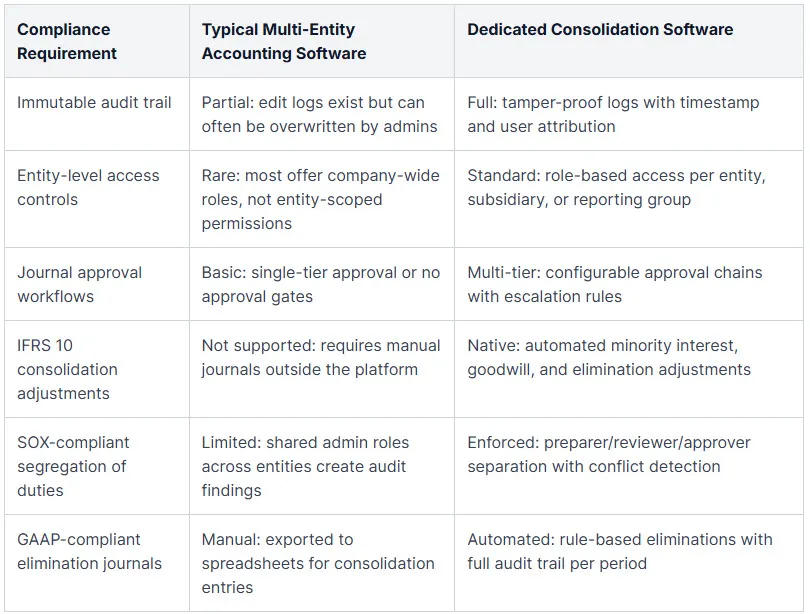
If your group faces IFRS or US GAAP statutory requirements, treat this table as a checklist during software evaluation. The gap between operational accounting tools and compliance-ready consolidation platforms is where audit findings live.
5. When Should You Graduate from Multi-Entity Accounting to Dedicated Consolidation Software?
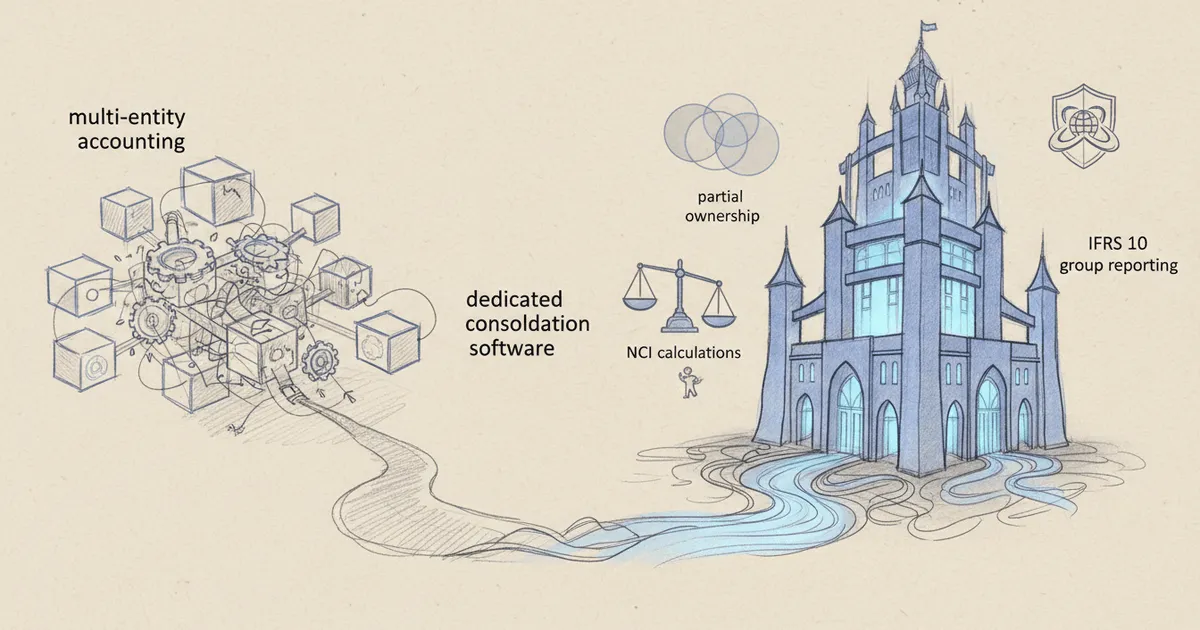
Graduate to dedicated consolidation software when partial ownership structures, NCI calculations, or IFRS 10 group reporting exceed your current platform's native capabilities.
The conventional wisdom is that multi-entity accounting software "does consolidation." It doesn't. Aggregating trial balances across five entities into a single report isn't consolidation. True group consolidation requires elimination logic, NCI (non-controlling interest) allocations, goodwill impairment testing, and multi-tier subsidiary roll-ups that operate above the general ledger. About 40% of multi-entity users end up needing add-ons to achieve anything resembling real consolidation, according to LiveFlow's 2025 analysis. That number reflects a gap between marketing claims and operational reality that most buyers only discover mid-audit.
The cleaner way to think about this isn't "graduating" from one tool to another. It's recognizing that multi-entity accounting and group consolidation are separate disciplines. Your multi-entity platform handles day-to-day books: AP, AR, bank feeds, entity-level P&L. Consolidation software handles everything that happens after the trial balances close: intercompany eliminations, partial consolidations, FCTR postings, and segmental reporting. Teams comparing Xero vs dedicated consolidation often discover this distinction the hard way during their first audit.
One PE-backed group running partial ownerships across 15 entities moved from a general-purpose platform to a dedicated consolidation tool and cut their close cycle by 50%. The trigger wasn't entity count alone. It was the moment IFRS 10 required them to calculate minority interests on three subsidiaries with different ownership percentages.
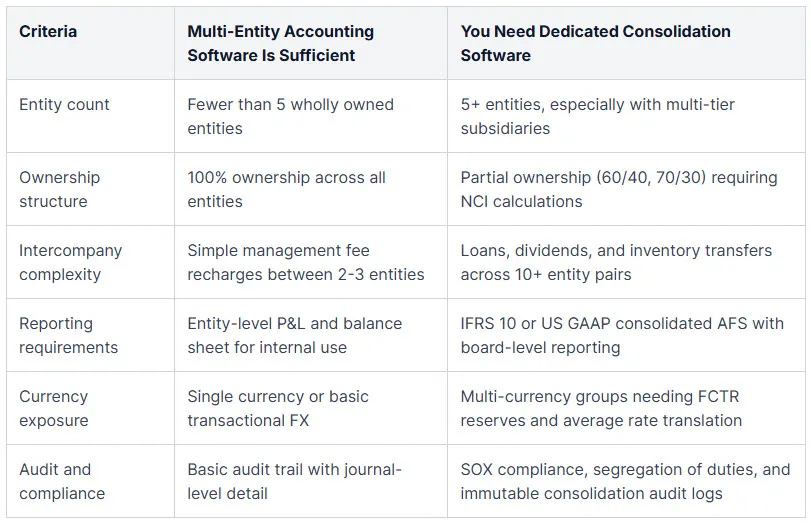
Quick Consols sits in this dedicated consolidation layer, designed to complement your existing multi-entity accounting tool rather than replace it. The two work as a stack: your GL platform feeds entity-level data, and the consolidation layer handles everything from eliminations to group financial statements.
6. How to Choose the Right Multi-Entity Accounting Software for Your Group
Evaluate multi-entity accounting software on six criteria: GL integration depth, entity scalability, intercompany handling, multi-currency logic, reporting granularity, and API access.
Start with integration. Your multi-entity platform needs to connect cleanly to whatever general ledger your entities already run. Sage Intacct scales to 50+ entities natively, which suits mid-market groups that don't want to rip out their existing chart of accounts. For smaller groups, entry-level platforms handle basic multi-entity bookkeeping but often cap out on intercompany automation.
The real evaluation isn't about picking one tool. It's about designing the full stack. Multi-entity accounting covers operational books: cost centres, profit centres, entity-level reporting. Financial consolidation software covers group reporting: eliminations, NCI, consolidated AFS. Treating these as one buying decision leads to compromises in both directions. You either get a bookkeeping tool that fakes consolidation or an enterprise platform that's overkill for daily AP runs.
API access deserves more weight than most buyers give it. A platform with open APIs lets you pipe trial balance data directly into your consolidation layer without CSV exports or manual re-keying. In 2026, API-first architecture is the difference between a three-day close and a five-day close for groups running 10+ entities. If a vendor can't show you a documented API with entity-level endpoints, that's a red flag for any group expecting to scale beyond its current structure.
Frequently Asked Questions About Multi-Entity Accounting Software
What is multi-entity accounting software?
It's a platform that lets finance teams manage general ledgers, invoicing, and entity-level reporting for multiple legal entities from a single login. This is distinct from consolidation software, which produces group-level financial statements with eliminations and NCI adjustments.
What is the difference between multi-entity accounting software and financial consolidation platforms?
Multi-entity accounting handles day-to-day bookkeeping across entities: recording transactions, running payroll journals, and producing entity-level trial balances. Consolidation software takes those trial balances and performs group-level work, including intercompany eliminations, foreign currency translation, and IFRS or US GAAP consolidated reporting. Most growing groups with partial ownership structures need both.
How much does multi-entity accounting software cost in 2026?
Cloud-based entry-level tools typically run £30 to £50 per month per entity. Mid-market platforms like Sage Intacct or enterprise ERPs can range from £500 to £2,000+ per month depending on entity count and module selection. Consolidation add-ons are priced separately and often scale with group complexity.
Can Xero or QuickBooks handle multi-entity accounting?
Yes, both support multiple entities through separate organisation files. They lack native intercompany elimination, consolidated group reporting, and consolidation-level currency translation. Dedicated consolidation software bridges that gap.
When should a business switch from spreadsheets to multi-entity accounting software?
At three or more entities, or when your month-end close regularly exceeds five working days due to manual data gathering. Each additional entity compounds the risk of copy-paste errors, broken formulas, and version control failures that auditors will flag.
Ready to Move Beyond Multi-Entity Bookkeeping?
If your group has hit the ceiling of what entity-level bookkeeping can produce, the next step is a consolidation layer that automates eliminations and delivers audit-ready group financial statements. Explore Quick Consols' financial consolidation software to see how it connects to your existing accounting platform and handles the complexity your spreadsheets can't.

Share this Article


Get in Touch
If you have any questions about our Consolidation Software, send us a message below and we'll get back to you ASAP.