
Accounting for the disposal of a subsidiary
The corporate world is marked by constant shifts in ownership structures, strategic priorities, and market dynamics. Companies often face difficult decisions about which investments to retain and which to let go of. One of the most complex of these decisions is the disposal of a subsidiary. Whether prompted by financial necessity, a realignment of long-term strategy, or the desire to streamline operations, divesting a subsidiary carries significant financial, strategic and operational implications.
Interestingly, the process of losing control over a subsidiary can be compared to the end of a meaningful relationship. Much like a breakup, it requires careful navigation to part ways. The decision often stems from a misalignment of goals or priorities, where the maintenance of the relationship no longer serves mutual interests. Shared aspects, such as intertwined operations or resources, must be disentangled and redistributed thoughtfully.
As with a breakup, the experience can bring mixed emotions. On the one hand, there might be relief (again) or there may be a sense of loss and reflection on what once was. Retained interests, such as ongoing involvement in the form of minority stakes or collaborative ventures, mirror staying connected through mutual friends or co-parenting. Moreover, disclosures—whether to stakeholders or one's personal network—become a necessary part of explaining the transition.
Just as in personal growth after a breakup, the disposal of a subsidiary provides an opportunity for a company to refocus its energy and resources, aligning with new goals and exploring new opportunities. The process, while challenging, ultimately marks a step forward in pursuit of a better-aligned future.
Loss of control of a subsidiary normally occurs when the parent / holding company (‘P Ltd’) sells shares to the non-controlling interest (NCI) in the subsidiary company (‘SLtd’). This represents a significant economic event and the parent company is required to stop consolidating and recognise a gain/loss in its separate and consolidated financial statements.
Other reasons that could lead to a loss of control are:
· The expiring or change of a contractual agreement which had originally resulted in the parent company having control, such as a change in management of the subsidiary.
· A rights issue or share buyback that will result in a dilution of shares – if the subsidiary company issues more shares and the parent company has limited or no participation in the offering, this could lead to a change in the percentage of ownership and the loss of voting power.
· Regulatory or Legal Changes – For example a regulatory body steps in if a merger or acquisition occurs that causes anti-competitive concerns and the parent company is forced to divest its interest in the subsidiary.
This article addresses the accounting implications in the parent's separate financial statements and the group's consolidated financial statements for the disposal of a subsidiary where control as defined by IFRS 10 Consolidated Financial Statements is lost through the buying and selling of shares between existing shareholders and a simple investment is retained.
Important considerations when losing control:
Date of losing control – This is normally the date when the parent company legally receives the consideration for its shares however there could be an earlier date if the parent company loses control on the date a written agreement is entered into between the parent company and the NCI or S Ltd.
Consideration received – The consideration received should be measured at its fair value in accordance with IFRS 13 Fair Value Measurement.
PARENTS SEPARATEFINANCIAL STATEMENTS
P Ltd is required to recognise a profit or loss on the disposal of its investment (shares) in the subsidiary just like it would recognise a profit or loss on the disposal of any other asset. The accounting for the loss on disposal will be dependent on the accounting policy that P Ltd has chosen to account for the investment in the subsidiary in its separate financial statements. IAS 27 Separate Financial Statements paragraph 10 provides an entity with the options of cost, according to IFRS 9 Financial Instruments(fair value) or according to IAS 28 Investments in Associates and Joint Ventures (equity method).

Note 1:
In the separate financial statements of P Ltd, there is a disposal of an asset. The consideration received on disposal is higher than the cost and therefore profit is recognised.

Remeasurement of the retained investment to fair value through profit and loss as this is similar to a day one gain in terms of IFRS 9.B5.1.2A.

Note 2: All subsequent remeasurements to fair value are recognised in other comprehensive income.

Journals to account for the investment in the separate financial statements of P (Ltd):

The above journals should be reversed through pro-forma journals on consolidation as the group profit and group re-measurement will be calculated differently.
What would be different if P Ltd made an irrevocable election to measure the investment at fair value through other comprehensive income in its separate financial statements?
If P Ltd accounts for its investment in S Ltd using the fair value method. On the date of disposal, P Ltd revalues the investment to its fair value through other comprehensive income (IFRS 9.5.7.5). There will be no profit or loss on disposal as the carrying amount (CA) will be equal to the fair value of the investment.
P Ltd can choose to reclassify cumulative gains/losses that were recognised in other comprehensive income to retained earnings when the investment is disposed of (IFRS 9.B5.7.1).
What would be different if P Ltd measured the investment using the equity method in its separate financial statements?
If P Ltd accounts for its investment in S Ltd using the equity method the cost of the disposed investment to be derecognised would be the CA of S Ltd as determined by IAS 28. The carrying amount is calculated using the equity method as the initial cost of the investment plus P Ltd’s share of profit and other comprehensive income of S Ltd less the distributions received from S Ltd.
Due to the part disposal, P Ltd should account for cumulative amounts previously recognised in other comprehensive income in relation to the investment on the same basis as would have been required as if P Ltd has disposed of the related assets or liabilities. For example, P Ltd’s share of other comprehensive income resulting from a revaluation surplus would be reclassified to retained earnings.
CONSOLIDATEDFINANCIAL STATEMENTS
The following procedure should be followed when there is a loss of control (IFRS 10.25 andB97-99):

How is the group gain calculated in the consolidated financial statements (IFRS10.25)?

CA of the investment on the date control is lost is calculated as:

The two methods to measure NCI (IFRS 3.19):


Note 3: At the acquisition date 1 January 2021.
The net asset value is R224 000- representing 100% of the business.
P Ltd had purchased a 75% interest in S Ltd which is worth R168 000 (R224 000 x 75%). P Ltd had paid R182 000 in cash for this and therefore had paid a premium for the interest of R14 000 (R182 000 – R168 000). This premium is representative of goodwill.
At the acquisition date, the balance of NCI being measured at proportionate share is R56 000(R224 000 x 25%).
Note 4:
Up until the beginning of 2024 S Ltd has been profitable and was able to increase its retained earnings and revaluation surplus. P Ltd had a 75% interest and NCI had a 25% interest in the growth of this equity.
Growth in equity:
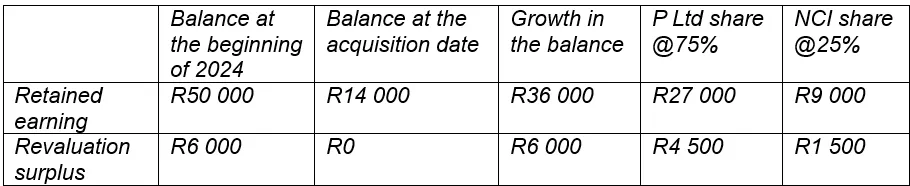
Note 5: The line items in the statement of profit or loss and other comprehensive income will be included in the consolidated statement of profit and loss as S Ltd was part of the group for the 12 months of the 2024reporting period.
If this was an interim disposal and S Ltd was disposed of on 30 June 2024 then only a portion (6/12)of each line item would have been included in the consolidated statement of profit and loss and other comprehensive income.
NCI 25% interest in the profit of 2024 is R1 750 (R7 000 x 25%).
P Ltd’s 75% interest in the profit of 2024 is R5 250 (R7 000 x 75%)
Note 6: The group gain to be recognised (group gain +remeasurement of the retained investment to its fair value) is calculated as:
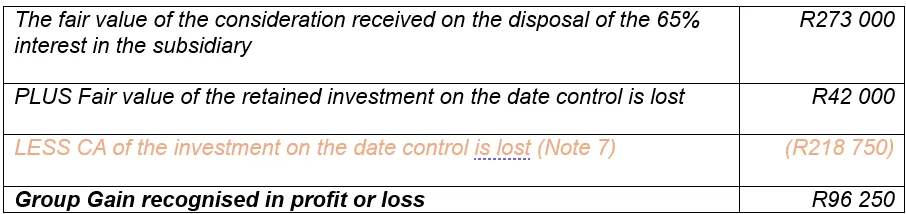
Note 7: CA of the investment on the date control is lost:

Note 8: Group gain on disposal to be recognised (excluding the remeasurement of the retained investment to fair value:

Note 9: Remeasurement of the retained investment to its fair value on the group level:

Note 10: Total to be recognised on a group level in profit or loss:

Pro-forma journals to account for the change in ownership in the consolidated financial statements of the Consol Ltd Group (single journal):
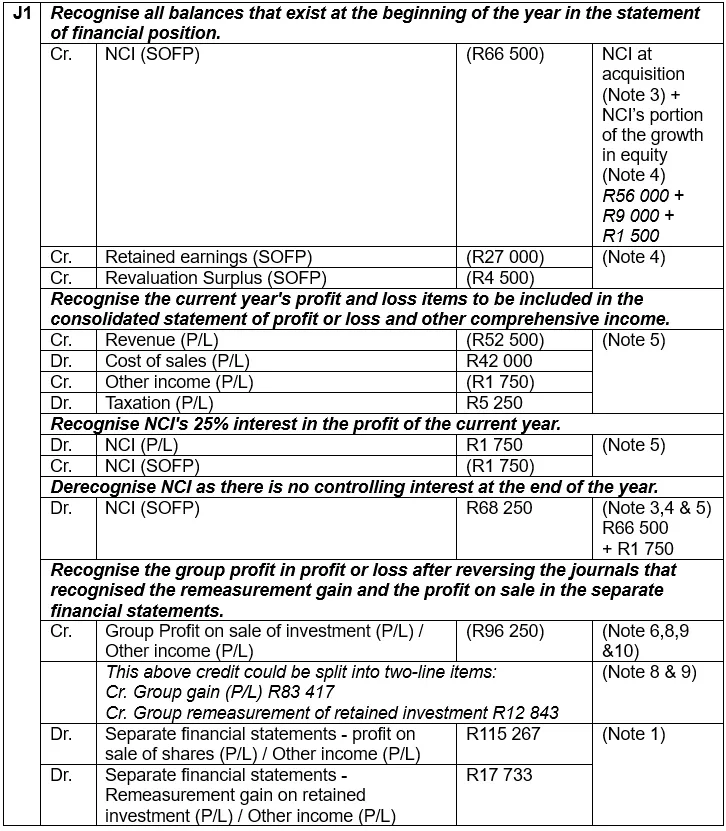

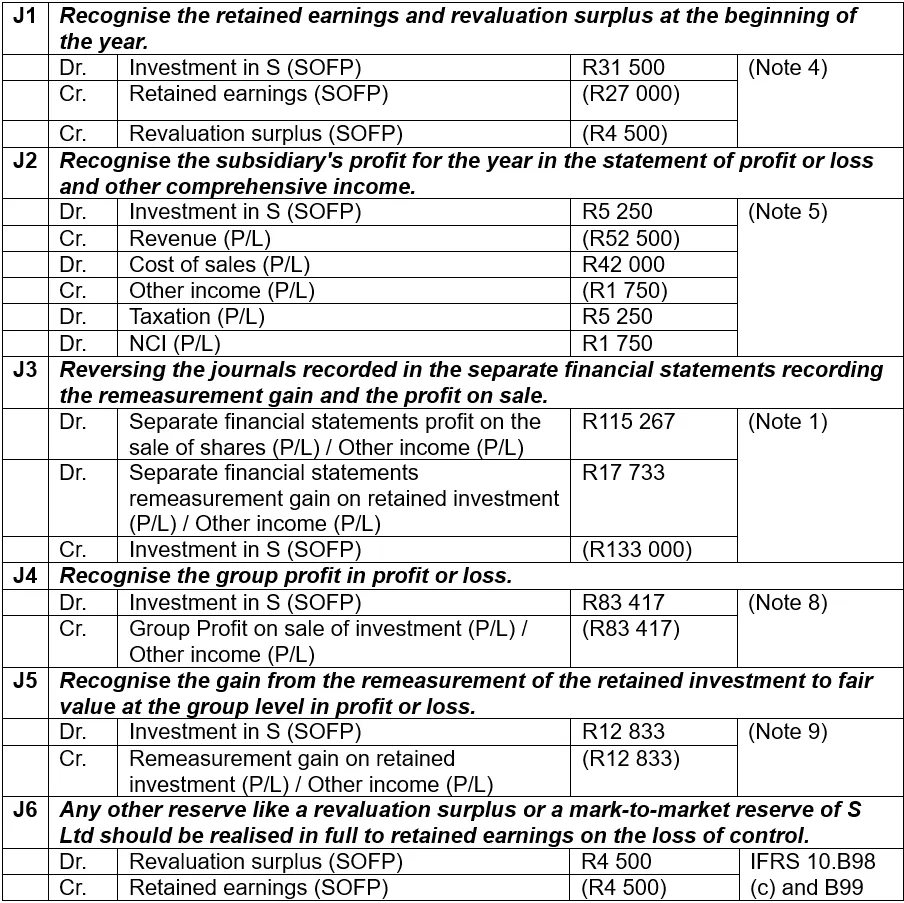
Alternative pro-forma journals to account for the change in ownership in the consolidated financial statements of the Consol Ltd Group (multiple journals):
What would be different if P Ltd retained no further interest in S Ltd?
There would be no consideration for the remeasurement of the retained investment in the separate or consolidated financial statement.
What would be different if P Ltd retained a 25% interest in S Ltd?
In the separate financial statements – The investment will continue to be held at cost in terms of IAS 27 and therefore there is no remeasurement of the retained investment to its fair value.
In the consolidated financial statements- If P Ltd retains 25% interest, the retained investment would need to be classified as an associate and accounted for in terms of IAS 28. The equity accounting approach will follow from the date control is lost.
P Ltd will need to account for its share of profit and other comprehensive income and eliminate any dividends received in the consolidated financial statements (IAS 28.10).
The pro-forma journals to be subsequently recorded will include:

What would be different if NCI was measured at fair value instead of at its proportionate share?
The goodwill at acquisition will be reflective of the goodwill belonging to NCI and the parent as it is the full goodwill approach. This will impact the amount recognised as good will and NCI at acquisition.
Disclosure requirements:
Notes to the financial statements:
The following disclosures are required by IFRS 12 Disclosures of Interests in Other Entities paragraph 19:
· The total gain or loss as a result of the loss of control
· The portion of the gain or loss attributable to measuring any retained investment in the former subsidiary to its fair value
· The line item in the statement of profit or loss in which the gain or loss is recognised

Further disclosure is required in terms of IAS 7 Cash Flows:
· The total consideration received
· The portion of the consideration consisting of cash and cash equivalents
· The amount of cash and cash equivalents in the subsidiary over which control is lost
· A summary of the amounts of assets and liabilities other than cash or cash equivalents in the subsidiary over which control is lost

The consolidated statement of financial position
The consolidated statement of financial position will not include any balance relating to the assets and liabilities of the disposed subsidiary as it is disposed at year end. The retained investment will be presented as a simple investment as a financial asset.
The consolidated statement of statement of profit or loss and other comprehensive income
Each line item of profit or loss and other comprehensive income of the disposed subsidiary will be included in the statement of profit and loss and other comprehensive income up until the date it is disposed of. If it was disposed of at the end of the reporting period it will be included for the full year, however, if it was disposed of during the reporting period it will be included on an apportionment basis.
The other income line item will include the group gain or loss that is recognised on the loss of control (disposal of shares) and the group gain or loss on the remeasurement of the retained investment.
The consolidated statement of changes in equity
The effect of the disposal of the subsidiary should be shown as a current-year movement in the consolidated statement of changes in equity. This line item will derecognise the closing balance of NCI.
The consolidated statement of cash flows
The cash portion of the consideration received from the disposal of the subsidiary should be presented as an investing activity in the consolidated statement of cash flows. This amount is presented net of the bank balance of the subsidiary over which P Ltd has lost control.
This article does not address the following but if you have questions relating to this, the team is available to assist you:
· Tax considerations for the disposal of the subsidiary.
· The accounting for when the subsidiary is held for sale.
· The accounting to recognise the impairment of a subsidiary.
· The accounting for the sale of a subsidiary by an investment entity.
· The partial disposal of a subsidiary where control is retained.
· Loss of control due to a share buyback or a rights issue.
· Intercompany journals when there is a disposal of shares.
Get in touch
The only thing we love more than Goodwill calculations are our customers. If you’d like to see how we can automate your consolidation, group reporting or financial statement preparation with the Quick Consols consolidation software and financial statement software, we’d love to hear from you and show you the software in a one on one demo.
You can follow our Linkedin page here for regular updates and take a look at our other content here.

Share this Article


Get in Touch
If you have any questions about our Consolidation Software, send us a message below and we'll get back to you ASAP.
Read this next
.webp)