Financial Consolidation Software Demo: What to Look For
Financial Consolidation Software Demo: What to Look For
How many hours has your team spent evaluating consolidation tools, only to discover three months post-implementation that the software can't handle your intercompany eliminations properly? According to HighRadius, mismatches between software capabilities and actual multi-entity workflows remain the top driver of buyer regret in financial consolidation purchases.
The frustrating part is that most vendor demo pages don't help you avoid this. Across the top-ranking consolidation software providers, not a single demo page exceeds 500 words of original written content. You're expected to make a decision that affects every monthly close, every audit cycle, and every set of group financial statements based on a 60-second product video and a form submission.
Mid-market and SME finance teams get hit hardest. Enterprise-focused demos showcase features built for organizations with dedicated implementation consultants and six-figure budgets. If you're a financial controller managing 8 to 40 entities across multiple currencies, those demos won't reflect your reality. They'll show you a polished version of a workflow you'll never actually use.
This guide gives you a structured framework for evaluating any financial consolidation software demo and walks you through exactly what to look for before signing a contract. Treat it as your pre-purchase checklist, whether you're comparing two vendors or five.
The pages that rank for "financial consolidation software demo" right now are thin. Most are just a video player with a form. That's a disservice to finance teams making consequential purchasing decisions under time pressure. What follows is the evaluation guide those pages should have been.
What Is Financial Consolidation Software and Why Does a Demo Matter?
Financial consolidation software automates the process of combining financial data from multiple entities into unified group statements. It handles intercompany eliminations, currency translation, and compliance reporting across both IFRS and US GAAP frameworks.
The software fundamentally replaces the spreadsheet-driven process most finance teams still depend on for group reporting. Rather than manually extracting trial balances from each subsidiary, mapping accounts in Excel, and running elimination journals by hand, a specialized platform handles all of these steps automatically. The result is a unified set of consolidated group statements that complies with IFRS, US GAAP, or local GAAP requirements.
The core functions fall into five categories:
- Multi-entity data aggregation: Pulling in trial balances and financial data from every subsidiary, no matter what ERP or accounting platform they're running
- Intercompany matching and elimination: Spotting and removing intercompany transactions (loans, sales, receivables) so the group statements only reflect external activity
- Foreign currency translation (FCTR): Converting subsidiary financials into the group's presentation currency, applying the right rates for balance sheet items, income statement items, and equity
- Minority interest and NCI calculations: Splitting equity and profit between the parent and non-controlling interests with precision, based on actual ownership percentages
- Audit-ready reporting: Producing consolidated financial statements, segmental reporting, and supporting schedules that come with a full audit trail
So why can't you evaluate these capabilities from a product page alone? Because consolidation logic is deeply tied to your specific group structure. A tool that handles straightforward 100%-owned subsidiaries well might completely fall apart when you introduce partial consolidations at 60% ownership. It gets worse if you need cost centre and profit centre segmental breakdowns that don't map cleanly to your chart of accounts.
A demo is the one point in the buying process where you can actually confirm whether the software handles your specific entity hierarchy, your intercompany transaction volume, and your reporting needs. Skip it, or settle for a generic recording, and there's a good chance your finance team ends up back in spreadsheets within six months.
As per Fathom's consolidation software analysis, certain platforms handle up to 97 currencies and 300 entities, while others cap out at 50. That's a massive gap. If your group runs cross-border operations, a hands-on evaluation isn't optional, it's the only way to know whether a platform can actually keep up.
How Does the Financial Consolidation Process Work in a Demo?
A consolidation demo should walk through eight sequential steps, from data import through final consolidated output, mirroring the actual month-end close process your team runs today.

Most on-demand demo recordings compress the consolidation cycle into a highlight reel. That's a problem. The real value of a demo is seeing how each step connects to the next, and where your specific group structure might create friction. Anaplan's on-demand demo, for instance, focuses heavily on automated eliminations and real-time visibility but doesn't let you test how the tool handles a partial acquisition at 75% ownership with a different functional currency than the parent.
A financial controller at a manufacturing group with 14 subsidiaries across three continents will hit different pain points than someone consolidating five domestic entities. During a live demo, you can feed in your actual entity hierarchy and see whether the software handles your intercompany loan balances, your minority interest splits, and your FCTR reserves correctly. An on-demand recording can't do that.
Here's what each step should look like, and what should raise concerns:
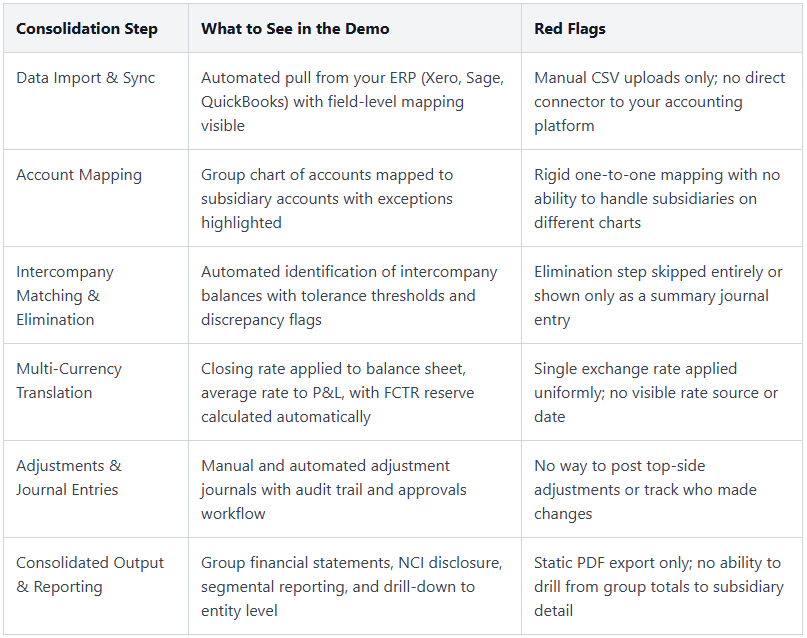
The elimination step deserves extra scrutiny. If a vendor glosses over intercompany matching or shows it as a single button click without revealing the underlying logic, ask them to demonstrate a scenario where intercompany balances don't match. That mismatch handling is where consolidation tools either prove their value or expose their limitations.
For mid-market teams without a dedicated IT department, pay attention to how much configuration each step requires. If the demo presenter needs to write custom scripts or call in a technical consultant to set up a basic entity hierarchy, the implementation timeline and cost will likely exceed what you've budgeted.
What Demo Format Should You Choose: Live 1:1, On-Demand, or Guided Tour?
Three demo formats exist for consolidation software: live one-to-one, on-demand recorded, and self-guided interactive tours, each suited to a different stage of your evaluation process.
The common advice is to start with a live demo so you can ask questions right away. That's actually backwards for most mid-market buyers. Booking a 1:1 call before you understand a vendor's basic approach wastes your time and the vendor's. You'll spend 20 minutes on introductions and product philosophy when you could have screened the tool out in 5 minutes from a recording.
Start with on-demand recordings to build a shortlist. Then book live sessions with your top two or three candidates.
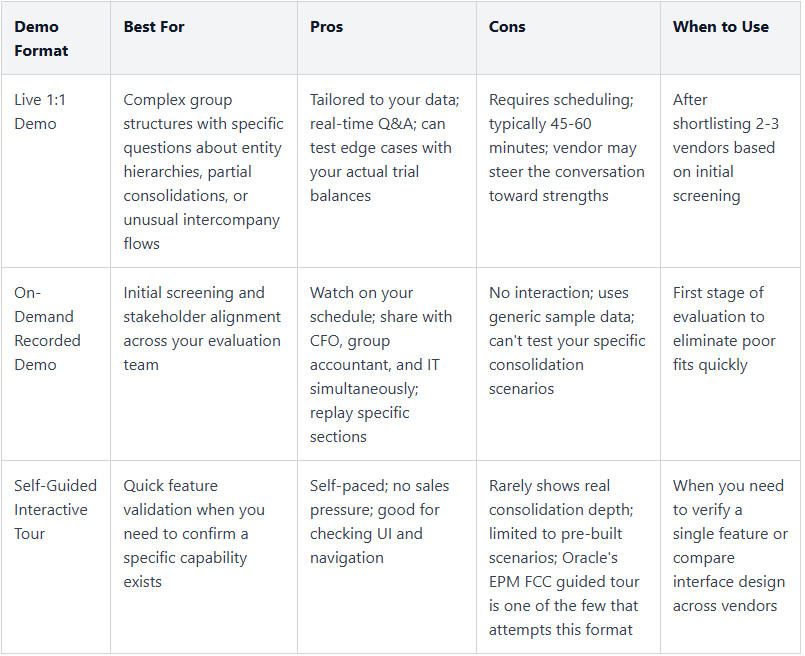
Your evaluation team should include at least the financial controller (workflow fit), a group accountant (daily usability), and someone from IT or operations (integration feasibility). On-demand demos let all three watch independently before you invest in a coordinated live session.
One nuance that gets overlooked: on-demand demos from enterprise vendors often show minimal content, sometimes under 60 seconds of actual product footage. If a recorded demo doesn't cover the full consolidation cycle from import to consolidated output, it isn't saving you time. It's hiding gaps. Platforms that simplify complex group consolidations tend to be more transparent in their demos because the workflow is designed to be understood without a consultant walking you through it.
The live 1:1 session is where you pressure-test. Bring your actual chart of accounts. Ask the presenter to set up your entity hierarchy on screen. Request a currency translation using your real functional currencies. If they can't do it in real time, that tells you something about the product's flexibility.
What Consolidation Software Features Should You Evaluate During a Demo?
Evaluate consolidation software demos across eight feature categories: data integration, consolidation engine, multi-currency, eliminations, reporting, compliance, user experience, and support quality.

Most demo evaluation mistakes come from focusing on the reporting output (the dashboards look great) while ignoring the engine underneath. A polished consolidated balance sheet means nothing if the intercompany elimination logic can't handle your actual transaction flows. Work through the demo systematically, category by category.
The table below gives you a concrete checklist to bring into any demo session. Print it, share it with your evaluation team, and score each vendor against the same criteria.
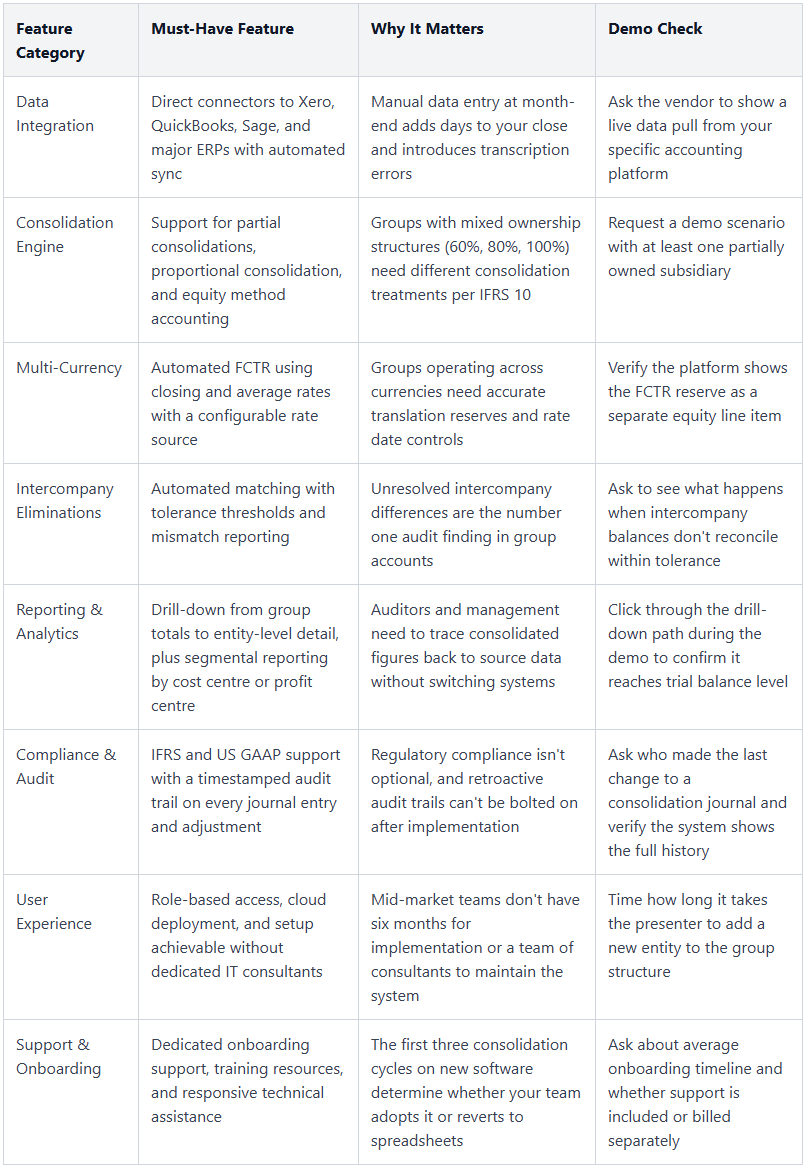
The user experience row deserves more weight than most buyers give it. A tool can tick every technical box and still fail if your group accountant can't run a consolidation without calling support. During the demo, watch how many clicks it takes to go from imported trial balances to a finished consolidated AFS. More than a dozen steps, and the daily workflow will feel heavy.
Some consolidation tools support up to 97 currencies and 300 entities according to published feature comparisons, while others cap at 50 entities. If you're a growing group, ask about entity limits explicitly. Hitting a ceiling 18 months after implementation forces a painful migration.
How to Prepare for a Financial Consolidation Software Demo
Effective demo preparation requires documenting your group structure, listing current pain points, and preparing specific questions that test each vendor's consolidation logic against your actual entity hierarchy.
Most finance teams walk into demos underprepared. They let the vendor control the narrative, watch a generic walkthrough, and leave without knowing whether the tool can handle their actual consolidation cycle. According to Fuel Finance's analysis of consolidation software, groups range from 5 to 300 entities with wildly different intercompany transaction volumes. Without defined requirements before the demo, you'll get a presentation designed for someone else's group.
Start by mapping your group structure on paper. Write down the number of entities, each entity's functional currency, ownership percentages (especially any below 100%), and the volume of intercompany transactions per month. This document becomes your test script during the demo.
Next, list every manual workaround your team currently uses. If someone spends two hours each month reconciling intercompany loan balances in a spreadsheet, that's a specific scenario to replicate in the demo. If your group accountant manually calculates NCI splits because your current tool doesn't handle partial ownership, flag that.
Your tech stack matters too. Document which ERPs and accounting platforms each subsidiary uses. A group with three entities on Xero, two on Sage, and one on a legacy system needs to see that exact integration scenario demonstrated, not a generic "we connect to everything" claim.
Bring these 10 questions to every demo:
- Can you import our trial balances directly from [your specific platforms]?
- How does the system handle intercompany balances that don't match?
- Show me a partial consolidation at 70% ownership.
- What exchange rate sources does the platform use for FCTR?
- Can we run segmental reporting by profit centre across the group?
- How long does a typical onboarding take for a group our size?
- What happens when we add a new subsidiary mid-year?
- Show me the audit trail for a consolidation adjustment.
- Can multiple users work on the same consolidation simultaneously?
- What does your support model look like after go-live?
Identify who needs to attend. Your financial controller should assess workflow fit and consolidation logic. A group accountant or preparer should evaluate daily usability: how intuitive is the interface, how many steps to complete a cycle, how easy is it to spot errors. If your IT team manages integrations, they need to see the data connection setup.
Before the demo starts, write down your pass/fail criteria. For example: "The tool must handle our 12 entities across 4 currencies with automated eliminations and produce an IFRS-compliant consolidated AFS." If you're comparing the best financial consolidation tools, consistent criteria prevent the most polished presenter from winning over the most capable product. Set the bar before the sales pitch begins.
How Should You Score and Compare Vendors After the Demo?
Score vendors using a weighted scorecard across eight categories, with feature completeness weighted at 40% for mid-market buyers evaluating consolidation software demos.

The temptation after watching three demos in a week is to go with your gut. Resist that. Gut feel is how teams end up choosing the vendor with the best presenter rather than the best consolidation engine. A structured scorecard forces you to compare what actually matters: can the tool handle your FCTR rules, your NCI calculations, your partial consolidations?
Build your scorecard before the first demo, not after. Assign weights based on your group's priorities. For most mid-market finance teams running 5 to 50 entities, the weighting below reflects where failed implementations actually break down.

Have every evaluator on your team fill this out independently within 24 hours of the demo. Waiting a week lets recency bias from the last vendor warp everyone's memory. Compare individual scores in a short meeting and focus discussion on categories where scores diverge by two or more points.
Red flags should automatically disqualify a vendor or drop their total score by 30%. Vague pricing that requires a custom quote conversation before you see any numbers is the most common one. Implementation timelines longer than 90 days for a mid-market group, no sandbox or trial environment, and refusal to run a proof-of-concept with your trial balance data all signal that the vendor isn't built for your segment.
Green flags deserve bonus points. Vendors offering transparent, flexible monthly pricing remove the risk of long-term lock-in. Same-day support, onboarding measured in days rather than quarters, and willingness to load your actual data during the evaluation period all indicate a vendor confident enough in their product to let you stress-test it before signing.
Why Mid-Market Finance Teams Need a Different Demo Experience
Mid-market groups with 5 to 50 entities need demos focused on speed to go-live, low IT dependency, and pricing that scales with group size rather than enterprise complexity.
Most consolidation software demos are built to impress a room full of enterprise stakeholders: dedicated IT teams, implementation consultants, and project managers with 12-month timelines. If you're a financial controller at a 15-entity group who also handles the month-end close personally, that demo has almost nothing to do with your reality.
The global financial consolidation software market is growing at roughly 8.5% CAGR, projected to reach $3.2 billion by 2032 according to a DataIntelo market report. Much of that growth comes from mid-market and SME adoption as cloud-based solutions make consolidation tools accessible beyond the Fortune 500. The demo experience hasn't caught up. You're still watching walkthroughs designed for groups managing 200 entities across 40 jurisdictions when your actual question is: "Can I connect my Sage instance and produce consolidated group financial statements by Friday?"
The bigger problem isn't just demo design. Enterprise-oriented vendors often can't simplify their product for smaller groups even if they wanted to. Their architecture assumes a dedicated admin, a phased rollout, and a consulting partner. Mid-market teams should screen for three things during any demo:
Go-live speed. If the vendor can't show you a realistic path from signed contract to first automated consolidation in under two weeks, the tool is built for a different buyer. Ask for a specific client example with a comparable entity count.
IT independence. Your finance team shouldn't need a developer to configure foreign currency translation rules or set up new cost centres. During the demo, watch whether the presenter configures something live or switches to a pre-built environment. Pre-built environments hide complexity.
Pricing that matches your group. Enterprise vendors price per module, per entity, per user, or per some opaque combination. Mid-market buyers benefit from vendors that offer flexible monthly plans scaled to group size with unlimited users, so your cost doesn't spike when you add a subsidiary or bring on a new team member.
If the demo feels like it was designed for a company ten times your size, it probably was. Walk away and find a vendor whose default configuration matches your actual consolidation cycle.
What ROI Should You Expect From the Right Consolidation Software?
Mid-market finance teams typically recover 50 to 70% of their consolidation cycle time, with payback periods under 12 months for cloud-based tools priced for groups under 50 entities.

ROI from consolidation software isn't just a line item on a business case. It shows up in places your CFO won't see on a spreadsheet: the controller who stops working weekends during close, the auditor who doesn't send back 15 queries because the eliminations tie cleanly, the board that gets consolidated results three days earlier and makes a faster acquisition decision.
The most measurable gain is time. Teams still running manual consolidations in spreadsheets commonly spend 21 or more days on a full close cycle. Automated consolidation can compress that by up to 4 days per cycle, and for groups running monthly closes, that's 48 days recovered per year. Multiply that by the loaded cost of your finance team's time and the payback math becomes straightforward. Most mid-market implementations hit breakeven within the first year.
Error reduction is harder to quantify but arguably more valuable. A single misclassified intercompany transaction that survives into the group financial statements can trigger audit adjustments, restatements, or compliance findings under IFRS or US GAAP. The cost of one restatement (external audit fees, management time, reputational damage) often exceeds several years of software subscription fees.
ROI projections from vendor slide decks deserve skepticism. The way to validate them is during the demo itself. Ask the vendor to walk through a specific scenario: "Show me how a group with 20 entities and 3 currencies produces a consolidated trial balance, including minority interest adjustments, from data import to final output." Time it. Compare that to how long the same process takes your team today. That single comparison gives you a more honest ROI estimate than any marketing deck.
Hidden costs of choosing the wrong tool deserve equal attention. Re-implementation after a failed rollout typically costs 1.5 to 2 times the original project budget once you factor in data migration, retraining, and the productivity lost during the transition. Teams that skip the proof-of-concept stage during evaluation are the ones most likely to face this scenario. During every demo, push vendors to demonstrate how they handle your specific FCTR configurations, partial consolidations, and segmental reporting requirements. Generic walkthroughs hide the gaps that become expensive surprises six months after go-live.
Frequently Asked Questions About Financial Consolidation Software Demos
How long should a financial consolidation software demo take?
A thorough live demo runs 45 to 60 minutes. On-demand recordings usually cover essential features in 15 to 30 minutes. If a vendor needs over an hour just to walk through a standard consolidation cycle (data import, eliminations, currency translation, consolidated output), that's a red flag. Your team will likely inherit all that complexity during implementation.
Can I use my own data during a consolidation software demo?
Yes. The best vendors will offer a proof-of-concept phase where they load your actual trial balances and group structure into the system. It's the most reliable way to verify whether the tool handles your intercompany flows and NCI calculations correctly. Any vendor that won't work with real data before you sign a contract? Remove them from your shortlist.
What questions should I ask during a financial consolidation software demo?
Zero in on six areas: how intercompany eliminations get automated, which ERP connectors exist natively, what a realistic go-live timeline looks like for a group your size, how foreign currency translation is configured (fixed vs. floating rates, multiple translation methods), what ongoing support response times actually are, and what total cost of ownership includes beyond the subscription fee. Jot these down before the session and carve out time for each one.
What is the difference between financial consolidation software and ERP consolidation modules?
Specialized consolidation tools are built from the ground up for multi-entity group reporting. They handle partial consolidations, minority interests, and IFRS or US GAAP compliance with real depth. ERP consolidation modules, by contrast, are bolt-on extensions that attach to existing systems and often lack granular control over intercompany eliminations or multi-currency translation methods. Mid-market teams running 10 or more entities almost always find a dedicated tool quicker to deploy and far more accurate in its output.
How do I evaluate consolidation software if I only have 5-10 entities?
Prioritize setup speed and native ERP integration with your accounting platform, whether that's Xero, QuickBooks, or Sage. Don't bother with tools that require a dedicated implementation consultant for a group this size.
Should I watch an on-demand demo before booking a live demo?
On-demand demos let you assess baseline fit in 15 minutes, pinpoint the exact questions you need answered live, and share the recording with stakeholders who can't attend. When you walk into a live session already familiar with the product's interface, you're not sitting through a standard tour. You're testing edge cases, pushing on the details that actually matter to your team.
See Quick Consols in Action: Book Your Personalized Demo
You've built the evaluation framework; now apply it to a tool designed for mid-market finance teams managing multi-entity, multi-currency consolidations. Quick Consols automates intercompany eliminations and produces audit-ready group financial statements without the enterprise complexity or months-long implementation timelines. Book a personalized demo tailored to your group structure by exploring Group Financial Consolidation.

Share this Article


Get in Touch
If you have any questions about our Consolidation Software, send us a message below and we'll get back to you ASAP.